
How to Correct Incorrect Insurance Provider Directory Listings for Therapists
An incorrect insurance provider directory listing can make an in-network therapist appear unavailable, send prospective clients to the wrong location, or display insurance participation that does not match the payer's actual records. These errors can remain visible even after the therapist updates their CAQH profile or receives confirmation that a demographic change was submitted.
Correcting an insurance directory listing requires identifying the inaccurate information, confirming the therapist's actual network relationship, submitting the correction through the appropriate payer-maintenance process, and checking that the change appears in the public directory.
The process matters for independently licensed therapists, counselors, psychologists, and behavioral-health group practices that rely on insurance directories to help members locate participating providers. A directory correction is not the same as credentialing approval, and an accurate public listing does not replace verification of a clinician's participation in a specific insurance plan.
Why Incorrect Provider Directory Information Creates Problems
Insurance provider directories help health plan members locate clinicians who participate in their coverage. A directory may display the therapist's name, specialty, practice location, telephone number, network participation, telehealth availability, and appointment availability.
For someone trying to arrange counseling, that information influences whom they contact.
An inaccurate directory entry can therefore create problems before the prospective client ever reaches the practice.
A therapist who is accepting new clients may be marked as unavailable. An outdated telephone number may send calls to a disconnected line. A former office address can make an otherwise suitable provider appear too far away. A missing telehealth designation may prevent a therapist from appearing in searches filtered for virtual appointments.
There can also be insurance-related consequences. A member may believe a therapist participates with a particular plan because the insurer's website lists the clinician as in network. The practice may have different information in its contracting records, or the listing may refer to a different plan, location, or billing arrangement.
These situations need to be investigated individually.
An inaccurate directory entry does not automatically mean the therapist has lost credentialing or that claims will be denied. However, the same incorrect provider data may exist elsewhere in the insurer's systems, making the discrepancy worth checking before it affects scheduling or billing.
Recurring inconsistencies in provider identifiers and payer records can also contribute to the kinds of credentialing mistakes that delay therapist payments.
Common Insurance Directory Errors
For behavioral-health practices, the most important errors generally involve:
A therapist missing from the directory despite confirmed network participation.
A therapist displayed as out of network despite an active participation agreement.
An incorrect office address, telephone number, or contact email.
An outdated practice location still accepting directory referrals.
Incorrect availability for new clients.
Missing or inaccurate telehealth information.
An incorrect professional specialty or area of expertise.
A clinician displayed under the wrong practice or group.
Incorrect individual or organization information.
A former clinician remaining associated with a practice.
A listing appearing under the wrong insurance product or network.
Each problem can require a different correction route.
Changing contact information usually involves demographic maintenance. An incorrect network designation may need provider relations or network management to review the underlying contract and enrollment records.
Treating those two situations as identical is one reason directory corrections can remain unresolved.
Confirm the Error Before Requesting a Correction
The first step is to establish exactly what the insurer's directory displays and how that information differs from the payer relationship or practice information already confirmed.
Start with the insurer's member-facing directory, not the provider's website or a general internet search.
Search for the therapist using the correct insurance product or network. Record the clinician's name, practice location, specialty, appointment availability, and any network information displayed.
Take a screenshot and save the page address, along with the date the listing was reviewed.
A screenshot provides a record of the actual problem if the listing changes during follow-up or the insurer later reports that no error exists.
Check the Exact Plan and Network
A therapist may participate with an insurer's commercial network but not every insurance product that the company administers.
Commercial insurance, Marketplace products, Medicare Advantage, Medicaid managed care, employer-specific networks, and behavioral-health arrangements may have different participation requirements.
The insurer's brand name alone does not prove that the therapist participates with every plan carrying that name.
Review the specific plan and network before assuming the public listing is incorrect.
For an established clinician, useful records include the participating provider agreement, network confirmation, applicable effective date, payer correspondence, and any documentation identifying the insurance products covered by the relationship.
Therapists who are still waiting for participation approval should keep that situation separate from directory maintenance. The process of getting onto insurance panels as a therapist establishes the contractual and enrollment foundation that must exist before an in-network directory entry can be treated as accurate.
Determine if the Problem Is Public-Facing or Internal
A public directory problem does not always mean the payer's underlying enrollment record is incorrect.
For example, the payer may recognize the therapist as an active participating provider for claims but fail to display the clinician in its search results.
The reverse can happen. The public directory may continue displaying a clinician whose network participation has changed.
Ask the payer to identify the status held in its contracting and enrollment system, along with the record used to populate the public directory.
The correction should target the record that is actually wrong.
Identify the Exact Provider Information That Needs Correction
Insurance companies generally need enough information to identify the affected provider and the specific practice record.
For a solo therapist, this may be relatively straightforward. Group practices often have multiple clinicians, locations, NPIs, and payer relationships connected to a single organization.
Prepare a comparison of the information currently displayed and the information that should replace it.
Provider Identity
Record the therapist's:
Full professional name.
Individual Type 1 National Provider Identifier (NPI).
Professional license type.
Applicable specialty or taxonomy information.
Practice or organization name.
Organization Type 2 NPI, if applicable.
Tax identification information when the payer requests it through an authorized channel.
The purpose is to make sure the insurer is reviewing the correct individual and organization.
An individual therapist's NPI should not be confused with the group or organizational NPI used for billing.
Practice Location and Contact Information
Compare the public listing against the practice's current:
Physical service location.
Approved telehealth or virtual care arrangement.
Appointment telephone number.
Scheduling or administrative contact.
Practice website when displayed.
New-client availability.
Office hours, when the directory maintains them.
A billing address and a location where a patient can receive an appointment are not necessarily the same.
UnitedHealthcare's 2026 provider guidance, for example, emphasizes identifying appropriate care settings and locations for provider directory, credentialing, and claims purposes.
An office that receives mail should not automatically be presented as a location where the therapist meets clients.
Payer and Group Affiliation
For a group practice, confirm which clinicians are attached to the organization and which payer agreements apply.
A therapist may have a valid individual NPI but still be missing the correct affiliation under the group's tax ID or organization NPI.
That can be a payer-enrollment problem requiring further investigation, not merely a public-profile edit.
The practice should establish which records are correct before submitting the requested change.
Submit the Correction Through the Insurance Payer
Once the error is documented, the next step is to use the health plan's designated provider-maintenance process.
There is no single national portal that automatically corrects every commercial insurance provider directory.
Insurers and behavioral-health networks maintain their own provider records, submission methods, and administrative requirements.
The appropriate channel may be a secure provider portal, demographic update form, provider directory maintenance tool, provider services department, network representative, or delegated credentialing organization.
Start With the Payer's Provider Portal
For participating providers, the insurer's secure portal is often the most appropriate starting point.
Look for functions labeled:
Provider Data Management
Demographic Updates
Practice Information
Provider Directory
Directory Attestation
Provider Maintenance
Practice Profile
These labels vary among payers and can change as their portals are updated.
Official payer guidance illustrates the differences.
Aetna directs participating providers to its Provider Data Management functionality through Availity for applicable updates.
Cigna Healthcare instructs contracted providers to use its provider portal's online demographic change process.
Optum Behavioral Health identifies its Provider Express portal as a route for reviewing and updating practice information, including contact information, appointment availability, and directory attestation.
These examples demonstrate why it is important to use the process applicable to the insurer and network involved.
A correction submitted to an unrelated department may not reach the team responsible for maintaining the listing.
Include a Precise Description of the Error
Avoid vague requests that ask the insurer to update the therapist's entire profile without identifying the problem.
A more useful request should contain:
The affected insurer and network.
The clinician's full name and NPI.
The relevant group information, when applicable.
The exact directory listing or page.
The information currently displayed.
The correct replacement information.
Supporting documentation requested by the payer.
The date the error was identified.
A request for confirmation that the directory record has been corrected.
For example, a practice may need to explain that the public directory still displays a former office address even though the clinician's active practice location was previously confirmed by the payer.
That is a different request from asking the insurer to add a newly established service location that has not yet been approved.
The distinction prevents a straightforward correction from being confused with a new enrollment request.
Retain Submission Evidence
After submitting the request, save the confirmation number, submission date, and any correspondence from the insurer.
Record the department or representative responsible for the correction and the expected next communication.
Some issues can be resolved through the portal. Others require additional verification, supporting records, or contact with provider relations.
The administrative discipline used for insurance credentialing follow-up and provider record management applies here, although directory correction and initial credentialing remain different processes.
A submitted request is not the same as a verified correction.
Why CAQH and NPPES Updates May Not Fix the Listing
CAQH and the National Plan and Provider Enumeration System are important sources of provider information, but they are not substitutes for an insurer's own directory-maintenance process.
CAQH Provider Data Does Not Control Every Insurer Directory
The CAQH Provider Data Portal allows clinicians to maintain professional and practice information used by participating organizations.
Its provider guidance includes practice location information and a feature for previewing provider directory data that may be shared with health plans.
This makes CAQH relevant when the incorrect listing involves outdated practice details.
However, maintaining accurate information in CAQH does not prove that every insurer has applied the same information to its public website.
The payer may require its own attestation, provider update, or confirmation of the affected directory record.
Review the CAQH profile when an insurer's listing contains incorrect practice details. Correct the source information if necessary, then follow the payer's stated process until the directory reflects the appropriate information.
Routine CAQH profile maintenance and re-attestation remains a related but separate responsibility.
NPPES Is Not an Insurance Participation Directory
NPPES maintains NPI information for individual and organizational health care providers.
The NPI Registry can display provider demographic information, including names, addresses, and taxonomy information.
CMS states that covered health care providers must report changes to relevant NPPES information within 30 days of the change.
An inaccurate NPPES address should therefore be corrected through the NPPES process.
But an accurate NPI Registry entry does not establish network participation with a commercial health insurer.
CMS explicitly distinguishes possession of an NPI from provider licensing or credentialing.
A therapist can have accurate NPPES information and still be absent from an insurance provider directory.
Do Not Confuse Directory Corrections With Business Identity Changes
A practice name change, new DBA, or business entity change can involve additional IRS, tax, NPI, contracting, and billing considerations.
Those broader identity changes have their own sequence, covered in updating payer records after a therapy practice name or DBA change.
For a therapist whose legal and billing information is already correct, the immediate task is narrower: correct the inaccurate directory entry and verify its public display.
How to Handle Missing or Incorrect Network-Status Listings
Network-status errors deserve special attention because the insurer's directory may influence what prospective clients believe they will pay for therapy.
A therapist should not assume the public listing is definitive proof of a contractual relationship.
The participating agreement, applicable network, effective date, and payer confirmation remain essential.
The Therapist Is In Network but Missing From the Directory
Start with evidence of the active payer relationship.
Check the agreement, enrollment approval, effective date, and payer records for the relevant clinician or group.
Then contact the payer's provider-maintenance or network department and ask why the clinician is absent from the member-facing directory.
Possible areas to investigate include:
A directory publication problem.
An incomplete provider-location relationship.
An unverified profile or overdue directory attestation.
An incorrect group affiliation.
A discrepancy between the contracted network and the network selected in the search.
A clinician record that has not been activated in the directory.
Do not create a new credentialing application automatically.
First establish if the payer considers the therapist active in the applicable network.
When the insurer confirms that an existing participation record is correct, request the directory correction against that record.
Keep written confirmation of the provider's network status where available.
The Directory Says In Network but the Practice Believes Otherwise
This situation requires confirmation before the practice tells a prospective client that their services will be covered at in-network rates.
An old public listing can remain visible after a termination or other change. Another possibility is that the listing represents a different plan or participating entity.
Ask the insurer to confirm the active contract, network, plan, and effective or termination date.
Do not assume a therapist is in network merely because the public search result appears under the clinician's name.
If a client has already scheduled an appointment, the practice should communicate any unresolved insurance uncertainty clearly and verify benefits through the appropriate payer channel.
The difference between confirming provider participation and verifying the insurance information collected during therapy intake matters here. An active policy, a directory listing, and covered benefits for a specific service are different pieces of information.
A Client Has Already Received an Unexpected Insurance Bill
A directory error becomes more sensitive when a client relied on inaccurate network information before receiving care.
Preserve the directory screenshot or other evidence of the information the client received.
The client should contact the health plan to confirm the network status for the date of service and ask how the plan will review the discrepancy.
The practice should separately examine the claim, payer response, and contractual record.
Do not change the client's financial responsibility without first understanding the applicable plan terms and legal protections.
Certain federal protections apply when a member relies on inaccurate provider directory information and receives out-of-network care as a result. The precise circumstances matter.
If the payer denies a claim or processes it under an unexpected network status, the administrative response may overlap with investigating and appealing denied therapy insurance claims.
The directory error and claim dispute should have separate records so the practice can track both to resolution.
Directory Corrections for Behavioral-Health Practice Arrangements
Behavioral-health listings can be especially difficult to verify because the name of the insurance company does not always identify the organization maintaining the relevant provider network.
The correct correction route depends on the payer relationship.
Behavioral-Health Networks and Delegated Arrangements
An insurance plan may use another organization to administer its behavioral-health network.
The therapist may therefore need to determine which organization actually maintains the provider directory record or receives demographic updates.
Start with the contractual and enrollment information already held by the practice.
If the insurer's general provider services department cannot identify the affected behavioral-health listing, ask for the network administrator or department responsible for the behavioral-health provider file.
The purpose is not to create duplicate requests with every organization involved.
It is to establish which organization owns the correction and which public directory needs to change.
Group Practices With Multiple Clinicians
A group practice may have several therapists associated with the same organization, location, telephone number, and tax ID.
One clinician's listing may be accurate even though another clinician's record is incorrect.
Review the individual provider entry and group affiliation separately.
An update to the group address does not necessarily fix an incorrect clinician-to-location relationship. Similarly, adding a new clinician to a group does not prove the insurer has activated that clinician for every product under the organization's contract.
Document the affected individual NPI, group NPI, location, and plan before submitting the correction.
Groups managing multiple payer relationships benefit from documented administrative procedures for recurring provider-data work, particularly when different staff members handle credentialing and directory maintenance.
Telehealth-Only or Hybrid Therapy Services
A therapist offering telehealth may appear under an office location that is not available for in-person appointments, or the insurer may fail to show the clinician as offering virtual sessions.
Directory and provider-maintenance rules may distinguish physical service locations, virtual care settings, billing addresses, and other administrative addresses.
Confirm the location and care-setting instructions with the affected payer.
UnitedHealthcare introduced additional care-setting options in 2026 to distinguish office, virtual, home-based, and other service arrangements across credentialing, claims, and directory workflows.
An inaccurate public telehealth designation should be corrected through the insurer's applicable provider information process.
Do not use an unapproved physical address merely to make the therapist appear in a particular geographical search.
Medicare and Medicaid Listings
Medicare and Medicaid provider information should not automatically be maintained using commercial insurance procedures.
For Original Medicare, CMS states that much of the general information displayed on Medicare Care Compare comes from the Provider Enrollment, Chain, and Ownership System (PECOS).
An applicable Medicare enrollment correction may therefore need to be made through PECOS. CMS notes that public-facing updates may take additional time to appear.
Medicaid processes vary by state. A clinician may need to maintain information in the state Medicaid enrollment system, a managed care organization's network records, or both.
Confirm the responsible program before sending documentation.
The broader sequence of insurance credentialing and payer enrollment timelines can help practices understand why approval, enrollment, and public-directory publication are not always completed at the same time.
What the No Surprises Act Says About Provider Directory Accuracy
The federal No Surprises Act established requirements intended to improve the reliability of health plan provider directories and reduce financial harm when consumers rely on inaccurate information.
CMS explains that health plans and issuers must maintain processes to verify and update provider directory information at least every 90 days.
The federal framework also requires a process to update directory databases within two business days after receiving relevant changes from a provider or facility. Plans must have a process to respond to questions about provider network status within one business day.
Providers and facilities also have responsibilities to submit relevant directory information when they begin or terminate certain network agreements, make material changes, or receive applicable requests.
These requirements do not mean every correction submitted through a portal is guaranteed to appear on the public website within two business days. A database update, completion of a payer's review process, and public display are distinct administrative events.
CMS notes that detailed implementing regulations remain a consideration and that plans and issuers have been expected to implement the statutory requirements using a good-faith, reasonable interpretation.
The law also provides certain protections when consumers receive out-of-network care because they relied on inaccurate directory information. The application of those protections depends on the circumstances.
The practical lesson for a therapist is straightforward: retain the correction evidence, follow the payer's official process, and confirm that the directory entry displayed to members is accurate.
Follow Up Until the Public Listing Is Corrected
A directory correction should remain open until the practice verifies the updated information in the member-facing directory.
A confirmation email or portal message may establish that the insurer received the change. It does not necessarily prove the public listing now reflects it.
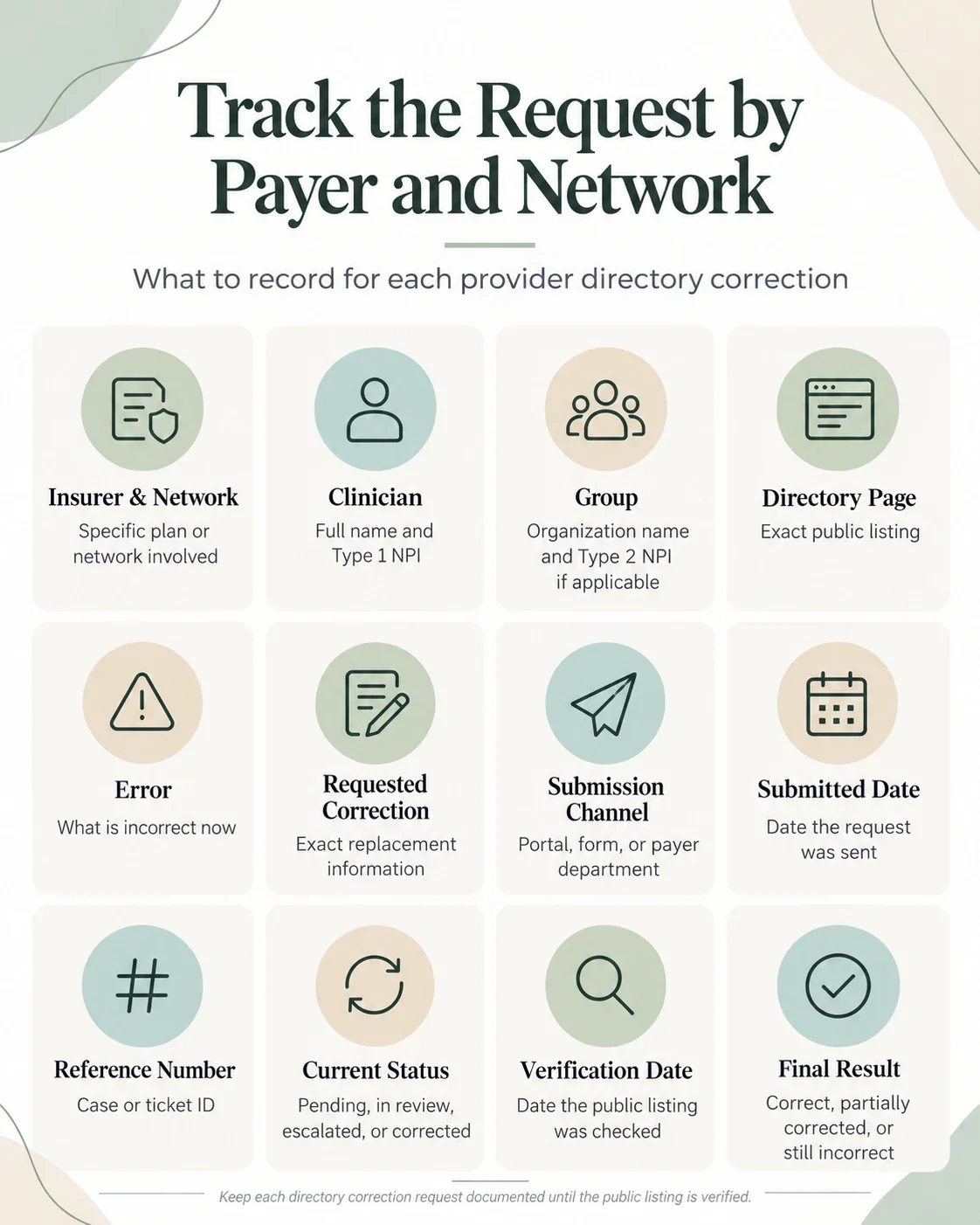
The tracker should distinguish a submitted request from a completed correction.
If the practice uses a ticketing system or centralized administrative workspace, the same information can be recorded there.
Check the Actual Public Search Result
After the insurer reports completion, repeat the original directory search.
Use the same plan, location, and relevant search filters that revealed the error.
Check the updated telephone number, appointment availability, network status, or other corrected fields.
Do not rely exclusively on a screenshot of the payer's internal profile or administrative portal.
A practice may have accurate internal information but still appear incorrectly in the member-facing directory.
Escalate When the Listing Remains Incorrect
If a submitted correction does not produce the expected result, contact the payer using the original case reference.
Ask which department owns the directory record, if any validation remains incomplete, and if the request requires another review.
For an unresolved network-status dispute, provider relations or network management may be more appropriate than a general demographic-update team.
When required corrections remain unresolved, the practice may consider the payer's formal provider dispute or complaint process and applicable state or federal regulatory channels. Which process applies depends on the plan and the nature of the issue.
Keep a factual written record of the steps already taken.
If incorrect provider data is contributing to claim problems, monitor the claims separately through the practice's normal unpaid claims and billing follow-up process.
A successful directory correction does not automatically resolve previously denied or unpaid claims.
Prevent the Same Information From Becoming Outdated Again
Provider directory maintenance should be a recurring administrative responsibility, not a task performed only after someone reports an error.
Payer networks can request periodic confirmation of practice information. Changes to staff, practice locations, availability, and service models create further reasons to review records.
Review Directory Information Regularly
Establish a schedule that satisfies the insurer's contractual and program requirements.
For example, Optum Behavioral Health directs contracted network providers to verify demographic information at least every 90 days, and its guidance explains that providers can risk temporary suppression from the directory when verification is not maintained.
Other payers and state programs may have additional requirements.
The practice should monitor those obligations according to the agreements and programs it participates in.
Review:
Network and plan information.
Name and professional credentials.
Current service locations.
Telephone numbers and contact methods.
Telehealth availability.
Acceptance of new clients.
Relevant specialties or areas of expertise.
Clinician affiliations.
Dates of recent verification.
Connect Directory Reviews With Practice Changes
A new location, newly added clinician, changed telephone number, or adjusted appointment availability should trigger a provider-directory review.
Do not wait for the next routine audit when the change has an immediate effect on how clients contact or locate the practice.
For example, if a therapist stops accepting new clients, the directory's availability field may need updating even though the clinician's license, payer agreement, and practice address have not changed.
That is a demographic maintenance issue, not a credentialing application.
Keep One Reliable Provider Information Record
Maintain an internal record showing the current information approved for each participating clinician and location.
This should serve as a reference for payer submissions, provider directories, scheduling staff, and administrative updates.
Access should be appropriate to staff responsibilities, particularly when the record contains tax identification details, payer credentials, or other restricted information.
Public-facing information can also be compared against the practice website and independent professional directories. HireGaynell's explanation of tracking where therapy client referrals originate addresses the separate question of measuring which referral channels actually produce inquiries.
The aim of directory maintenance is accuracy and accessibility, not manipulating search results or displaying participation that the payer has not approved.
When Administrative Support Makes Sense
A solo therapist with a small number of payer contracts may be able to review and maintain directory information personally.
The work becomes more demanding when several insurance companies, service locations, and clinicians are involved.
Each payer can require a different portal, verification cycle, submission method, and follow-up process.
Administrative tasks that can be assigned to an appropriately authorized staff member or specialized virtual assistant include:
Reviewing insurer listings.
Comparing directories with current provider records.
Preparing demographic corrections.
Updating CAQH information.
Submitting payer-maintenance requests.
Tracking confirmations.
Following up on unresolved records.
Documenting public-directory verification.
The therapist or practice owner still retains responsibility for confirming professional information and any decisions that require clinical, contractual, or licensed-professional judgment.
HireGaynell's virtual assistant support for behavioral-health provider administration includes provider directory and CAQH management. Its practice administration services address the broader recurring work involved in maintaining practice information and operational systems.
Administrative access should be configured according to the systems involved. If an outside administrator handles protected health information on behalf of a HIPAA-covered practice, appropriate privacy safeguards and business associate requirements may apply. These responsibilities are explained further in HIPAA-related administrative support for therapy practices.
Not every directory correction requires an outside specialist. The value of delegation grows when repeated payer requests and follow-ups begin consuming a meaningful amount of administrative time.
A Directory Correction Is Finished When the Right Information Is Public
Correcting an insurance provider directory listing requires more than submitting a form.
The practice first needs to establish what the directory shows, what the insurer's actual network and enrollment records confirm, and which information is wrong.
A demographic mistake should go through the appropriate provider-maintenance process. A missing network affiliation may require additional payer review. CAQH and NPPES records should be checked when relevant, but accurate source information alone does not prove that the insurer's public directory is correct.
The final verification takes place where clients encounter the information: the insurer's member-facing directory.
For a therapy practice, accurate directory listings are part of maintaining accessible contact information, reliable insurance records, and an organized administrative operation. Keeping those records current reduces avoidable confusion for prospective clients and gives the practice a clearer process when an insurer's information no longer matches reality.
Frequently Asked Questions
How do I correct an inaccurate insurance provider directory listing?
Identify the incorrect public entry, confirm the therapist's actual payer and network information, and submit a specific correction through the insurer's provider-maintenance process. Retain the submission confirmation, follow up with the responsible payer department, and check the member-facing directory to confirm that the change appears.
Why is my therapist profile missing from an insurance provider directory?
A missing profile can result from an incomplete directory record, incorrect provider affiliation, unverified demographic information, an outdated practice location, or a mismatch between the searched network and the clinician's contracted network. Ask the insurer to confirm the provider's participation status and the reason the listing is absent before submitting a new credentialing application.
Does updating CAQH automatically correct insurance directories?
No. CAQH maintains provider information that participating organizations can use, but each insurer controls its own provider directory and maintenance process. The practice may need to update CAQH and separately submit or confirm the change with the insurer.
How long does an insurance provider directory correction take?
The time depends on the payer, the type of discrepancy, and the record requiring correction. Federal directory-accuracy provisions address payer verification and database-update processes, but they do not guarantee that every public listing correction will be fully visible within a fixed period. Request the payer's estimated completion date and verify the public entry afterward.
Can an incorrect insurance directory listing affect claims?
It can indicate inaccurate provider information that may also affect claims, but a directory error alone does not establish that a claim will be rejected or denied. Check the payer's separate contracting, enrollment, and claims records. Investigate any claim problems according to the payer's actual response.
What if my insurance directory says I am out of network but I have a contract?
Confirm that the agreement applies to the exact product and network being searched. Provide the payer with the relevant participation information and ask network management or provider relations to review the clinician's status. Request a correction to the directory once the payer confirms the appropriate relationship.
Do insurance provider directories need to be updated every 90 days?
Federal law establishes processes for health plans to verify and update provider directory information at least every 90 days. Participating providers may also have contractual attestation duties. Exact submission and verification requirements can differ among payers and state programs.
Should a therapist update NPPES when correcting an insurance directory?
Only when the NPPES information itself needs correction. NPPES maintains NPI records; it does not control an insurer's network participation directory. A public payer listing can require correction even when the NPI record is accurate.
