
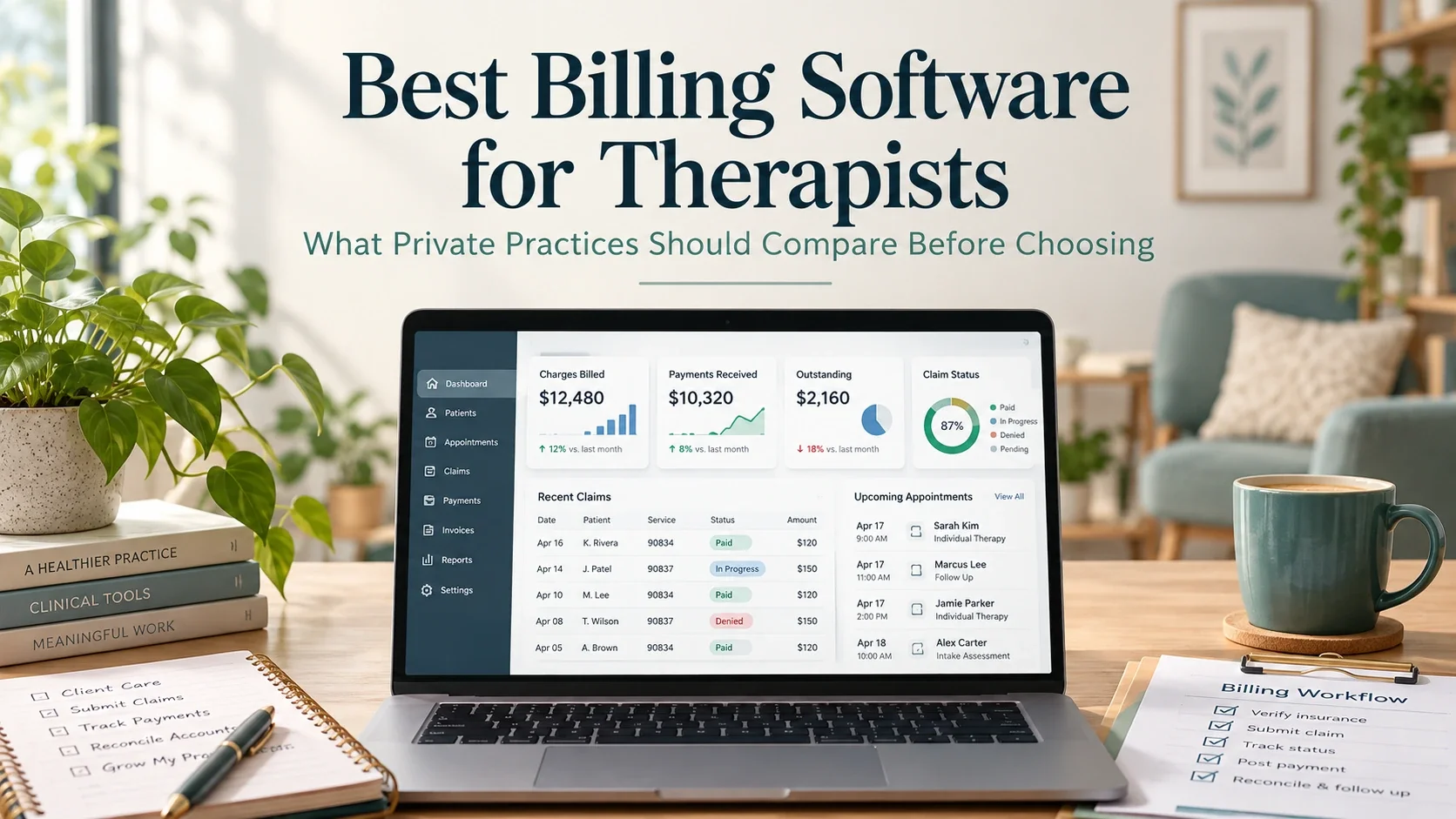
Best Billing Software for Therapists: What Private Practices Should Compare Before Choosing
Choosing billing software for therapists involves more than comparing monthly prices or checking if a platform can submit insurance claims. The right system should help a private practice manage claim status, payment posting, ERAs, unpaid balances, billing profiles, secondary claims, and follow-up without creating extra administrative work. This blog explains what solo therapists and group practices should compare before choosing billing software, with a closer look at how SimplePractice supports insurance billing and where human billing oversight is still needed.

Changing Your Therapy Practice Name or DBA: What to Update With Insurance Payers
Changing your therapy practice name or DBA affects more than branding. Learn how to update insurance payers, NPPES, CAQH, SimplePractice, EFT, ERA, and billing records without creating mismatched provider information.

Switching Mental Health Billing Companies: A Step-by-Step Checklist for Therapists
A practical guide for therapists and mental health practices switching billing companies, covering open claims, AR ownership, SimplePractice access, ERA/EFT setup, payer portals, handover records, and first-cycle reconciliation.














Reactivating Past Therapy Clients: The Ethical Win-Back System
You can reactivate past therapy clients ethically, and it's often the cheapest revenue a practice already has.
A message inviting a former client to resume their own care is a treatment communication under HIPAA, not marketing, so it needs no separate authorization when no third party pays for it. But the details decide whether you protect your license or risk it.
This guide covers the ethics of undue influence, the HIPAA treatment exception and TCPA texting rules, and the specific clients you should never contact.
You'll get a five-step win-back system, two ready-to-use re-engagement scripts framed around care rather than promotion, and the three numbers that tell you whether the campaign is working.
It also shows how to re-verify benefits and route returning clients to a fast intake, so a reactivated client actually books.
Written from hands-on behavioral health operations experience, for solo and small-group practice owners who bill insurance.

Referral Source Tracking: Know Where Your Clients Actually Come From
Referral source tracking answers one question with money attached: for every dollar of new revenue, where did it come from? Most therapy practices can't answer it, and the reason isn't missing software.
SimplePractice already ships with a "Referred By" field and a Referral Income Report. The field just sits empty on most charts, the source names are inconsistent, and nobody reviews the report.
This guide closes that gap. You'll learn how to set up referral source tracking in SimplePractice step by step, which sources actually deserve a line (directories, Google, physician referrals, word of mouth), why capture has to happen at intake instead of after the fact, and how to thank a referring provider without breaching HIPAA.
Written from hands-on behavioral health operations experience, it shows solo and small-group practice owners how to stop guessing at their marketing and finally see which two or three channels fund the practice.

W-2 vs. 1099 for Therapy Practice Support Staff: The Classification Call That Decides Who Owes the Back Taxes (2026)
Deciding whether your support staff should be W-2 vs 1099 therapy staff comes down to one thing the IRS cares about: control.
If you set the hours, direct the tools, and dictate how the work gets done, the law reads that as employment, no matter what the contract says.
This guide walks through the IRS three-part common-law test, then applies it role by role — front desk, intake coordinator, biller — so you know exactly which positions you can't classify as 1099, and which you can.
You'll see what misclassification actually costs in back taxes, interest, and penalties, why some states apply an even stricter test, and the real payroll-tax math behind the decision.
Most importantly, it explains the one 1099 arrangement that stays fully compliant no matter how much you lean on it: hiring an outside firm instead of mislabeling a person. Written from hands-on behavioral health operations experience, not theory.

Therapy Practice Waitlist Management: The 5-Step System, the Scripts, and When to Close the List Instead (2026)
A full caseload doesn't automatically justify a waitlist.
Therapy practice waitlist management only works when your capacity genuinely turns over, you commit to a contact cadence, and you have somewhere to route people who can't wait.
This guide gives you the operational system: cap the list at three times your monthly openings, capture only scheduling and insurance details, verify benefits before anyone waits a day, contact every person every 14 days, and fill openings in a fixed written order.
You'll get the exact language for adding someone to the list, running the 14-day check-in, and offering an opening.
It covers where the waitlist lives in SimplePractice, which plans include the feature, and the HIPAA rules that make a group email a reportable breach.
Then the harder call most owners avoid: the four signals that mean you should close the list and refer out instead.
Written from behavioral health operations experience.