
Virtual assistants working with therapists need HIPAA training relevant to the patient information they handle, the systems they use, and their responsibilities within a mental health practice. That usually includes patient privacy, secure communication, electronic health records, access permissions, and reporting potential security incidents.
Do virtual assistants need HIPAA certification? No government-issued HIPAA certification is required to become a mental health virtual assistant. However, applicable healthcare organizations must provide appropriate workforce training, and independent service providers handling protected health information must meet the requirements that apply to their business associate role.
For someone entering the mental health virtual assistant profession, understanding HIPAA is an important part of being prepared to support therapists safely. General administrative experience helps, but working with confidential health information introduces responsibilities that ordinary virtual assistance may not involve.
This guide explains what HIPAA training for virtual assistants should cover, which requirements depend on employment status, and how to prepare for real administrative work in therapy practices.
Do Virtual Assistants Need HIPAA Training?
Virtual assistants who handle protected health information for HIPAA-regulated therapy practices need training appropriate to their duties and working arrangements. The legal requirements depend partly on the VA's relationship with the practice.
For example, a virtual assistant employed by a HIPAA-covered therapy practice is generally part of its workforce. The practice must train workforce members on applicable privacy policies and procedures and provide required security awareness and training.
An independent VA business providing administrative services may instead qualify as a business associate. In that case, the VA must meet the HIPAA obligations applicable to its services, including contractual requirements and applicable Security Rule safeguards.
These distinctions matter because completing an online course does not automatically establish that a virtual assistant or therapy practice complies with HIPAA.
A VA supporting therapists may encounter protected health information (PHI) during:
Appointment scheduling and calendar management
Client intake coordination
Insurance eligibility verification
Billing and payment administration
Electronic health record management
Communication with existing clients
Not every administrative task requires access to patient information. A VA managing general website updates or non-clinical marketing materials might never need access to PHI.
The purpose of training is to prepare an assistant to recognise confidential information, understand their access limits, and perform authorised tasks without exposing client records.
What Should HIPAA Training for Virtual Assistants Cover?
Effective HIPAA training for mental health virtual assistants should cover privacy, security, patient information handling, and the specific administrative responsibilities they perform.
A general introductory course can establish basic knowledge, but it cannot replace the policies, tools, and instructions provided by the practice or business responsible for the information.
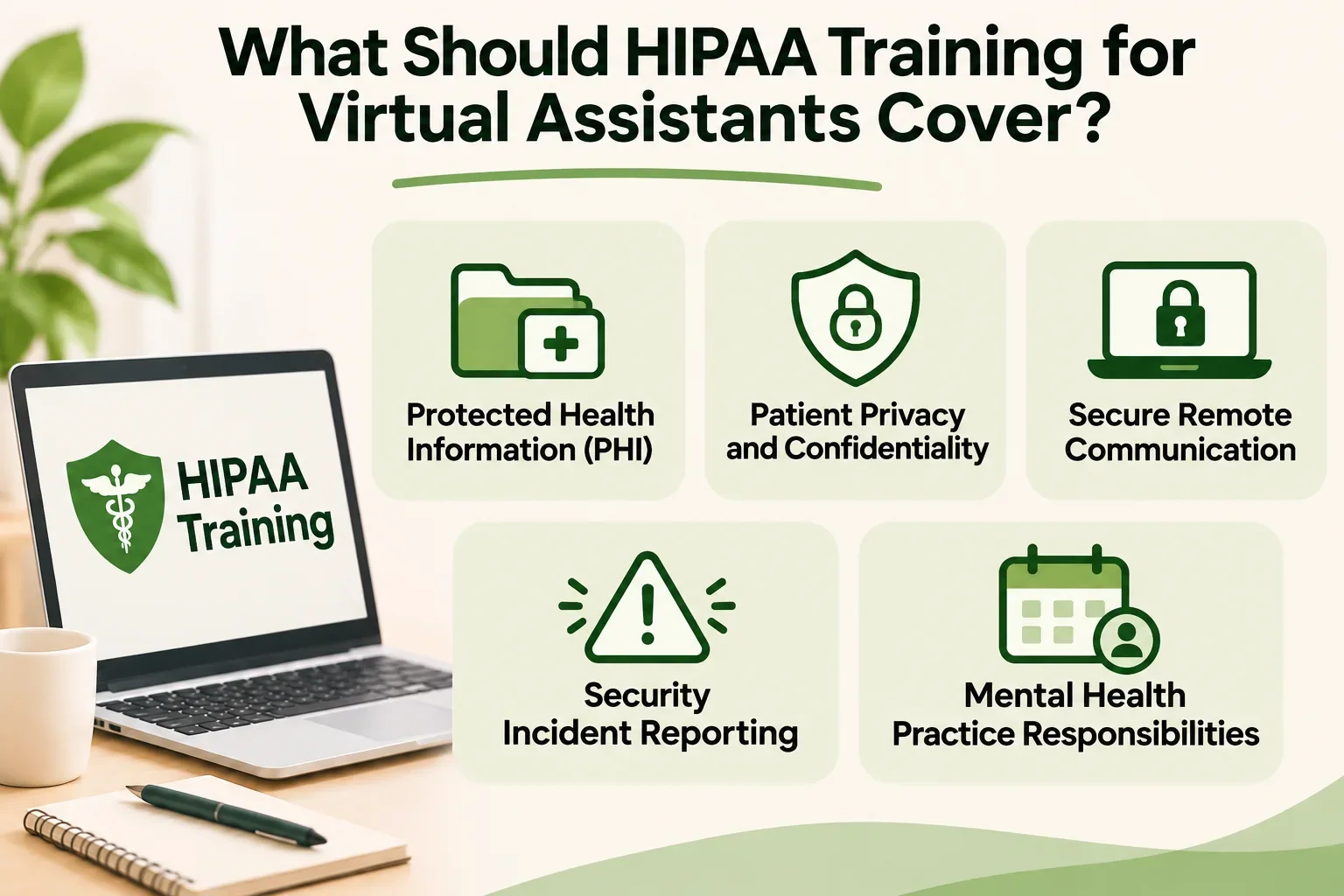
1. Protected Health Information (PHI)
PHI is individually identifiable health information held or transmitted by a covered entity or business associate, subject to the HIPAA definitions and exceptions.
In a therapy practice, examples may include a client's name associated with treatment, appointment records, diagnosis information, insurance details, and billing records.
Training should help VAs recognise PHI in ordinary administrative activities. A scheduling message might seem harmless, but it can contain information linking an identifiable person to mental health services.
2. Patient Privacy and Confidentiality
Virtual assistants need to understand when information may be used, shared, or accessed.
This includes the minimum necessary standard, which generally requires limiting applicable uses, disclosures, and requests for PHI to what is reasonably necessary for the intended purpose.
An assistant responsible for scheduling appointments does not automatically need access to clinical documentation.
3. Secure Remote Communication
HIPAA training for remote workers should address authorised communication systems, account security, document sharing, and approved methods for accessing information.
A VA should understand why forwarding a client document to a personal email account can create privacy and security risks, even when the intention is simply to finish a task faster.
4. Security Incident Reporting
Training should explain what to do when patient information is accidentally sent to the wrong recipient, a device is lost, or suspicious account activity appears.
VAs should know the practice's reporting procedure before an incident occurs.
5. Mental Health Practice Responsibilities
Therapy practices have administrative workflows that differ from many ordinary businesses.
A mental health VA may need training on appointment confidentiality, insurance-related information, referral communication, and the boundaries between administrative and clinical responsibilities.
These responsibilities are closely related to the systems described in HIPAA-compliant administrative support for therapists, although that article addresses the practice owner's perspective.
HIPAA Training vs HIPAA Certification: What's the Difference?
HIPAA training teaches privacy and security responsibilities. A HIPAA training certificate usually documents completion of a course; it is not proof of government-certified compliance.
This distinction is important for anyone searching for HIPAA certification for virtual assistants.
The U.S. Department of Health and Human Services does not certify individuals or private training providers as officially HIPAA compliant.
A training company may issue a certificate after a participant completes lessons or passes an assessment. That document can demonstrate participation in training, but it does not replace workplace policies, appropriate safeguards, or contractual obligations.
For aspiring mental health virtual assistants, useful training should provide an understanding of:
The HIPAA Privacy Rule
The HIPAA Security Rule
Protected health information
Secure administrative communication
Access permissions
Incident reporting procedures
Business associate responsibilities, when applicable
A VA can mention completed HIPAA training on a resume or professional profile accurately without claiming to hold an official government certification.
The practical goal is competence and responsible handling of information, not simply obtaining a certificate.
Can You Become a Mental Health Virtual Assistant Without Healthcare Experience?
Yes. Someone with administrative or general virtual assistant experience can prepare for mental health VA work without previously working in a healthcare practice.
However, experience in scheduling, email management, customer support, or data entry does not automatically prepare someone to handle confidential patient information.
A beginner needs to understand how therapy practices operate and how administrative work fits around the clinician's responsibilities.
For example, someone who previously managed appointments for a marketing agency may understand calendar systems. In a therapy practice, that same person must also learn how appointment details are protected, which messages can be shared, and how patient requests are handled.
An appropriate learning sequence includes understanding the mental health VA role, studying HIPAA fundamentals, practising with non-patient examples, and learning the relevant software permissions.
A prospective VA should also recognise the difference between knowing how to operate a system and being authorised to access real patient records.
This is one of the main distinctions between general administrative experience and specialised mental health virtual assistant training.
Understanding the HIPAA Privacy, Security, and Breach Notification Rules
Virtual assistants do not need to become HIPAA lawyers to perform administrative work. They do need a practical understanding of three connected rules.
HIPAA Privacy Rule
The Privacy Rule establishes protections for PHI and governs many circumstances involving its use and disclosure.
For a VA, this means understanding confidentiality, appropriate access, authorised sharing, and the patient's privacy rights.
A therapist's assistant should never assume that having access to a system means every piece of information inside it can be opened or shared.
HIPAA Security Rule
The Security Rule concerns electronic protected health information, commonly called ePHI.
It requires regulated entities to implement appropriate administrative, physical, and technical safeguards.
For remote virtual assistants, the relevant practices include protecting account credentials, following approved device policies, using secure systems, and recognising suspicious activity.
HIPAA Breach Notification Rule
The Breach Notification Rule establishes requirements for notifying affected individuals and others following certain breaches of unsecured PHI.
A VA's immediate responsibility is to follow the organisation's incident reporting process.
For example, if a client document is sent to the wrong recipient, the assistant should promptly report the incident through the designated procedure. The responsible organisation must assess the incident and determine applicable notification obligations.
The detailed process is covered separately in HIPAA breach notification for therapy practices, keeping the current article focused on training responsibilities.
Who Provides HIPAA Training and How Often Is It Needed?
HIPAA training may be provided through a covered healthcare organisation's internal programme, a qualified third-party training provider, or another appropriate educational resource.
There is no single HIPAA-approved course that every virtual assistant must complete.
For a covered entity's workforce, HIPAA requires relevant privacy training for new members within a reasonable period after joining. Additional training is required when material changes affect their functions.
The Security Rule also requires an ongoing security awareness and training programme.
HIPAA does not establish a universal requirement that every virtual assistant complete the same external certification course annually. An organisation may adopt annual refresher training through its own policies, contractual requirements, or other applicable obligations.
A VA working with multiple practices should understand that each organisation may have different approved communication systems, reporting procedures, and access policies.
Previous training provides useful background knowledge, but practice-specific onboarding remains important.
For independent VA businesses, training and documentation should also reflect their own applicable security obligations and business associate agreements.
Do Virtual Assistants Need a Business Associate Agreement?
An independent virtual assistant or VA company providing services involving PHI for a HIPAA-covered therapy practice will generally need an appropriate Business Associate Agreement (BAA).
A BAA establishes permitted uses and disclosures of PHI and describes contractual responsibilities for protecting it.
However, not every virtual assistant automatically needs a separate BAA.
An assistant who qualifies as a member of the practice's workforce generally does not require a separate BAA with that practice for their workforce duties. The HIPAA definition of workforce can include certain individuals under the entity's direct control, even if they are not traditional employees.
An independent contractor is not automatically classified the same way merely because a practice assigns tasks.
The actual working relationship determines which rules apply.
Before handling patient information, a VA should understand their relationship with the practice, the applicable agreements, their authorised duties, and any subcontractor restrictions.
A HIPAA course completion certificate does not replace a required BAA.
HIPAA Requirements for Virtual Assistants Working From Home
Working remotely does not remove HIPAA responsibilities.
A virtual assistant may work from a home office, another U.S. location, or outside the United States. Appropriate safeguards and lawful access arrangements remain necessary wherever PHI is handled.
Remote-work training should focus on practical risks.
Secure devices and accounts
VAs should use devices and accounts approved for their work, follow the organisation's password and authentication requirements, and protect equipment from unauthorised access.
Sharing a work login with another person can undermine accountability and security controls.
Private working environments
A remote assistant should prevent unintended disclosure through visible screens, overheard conversations, exposed documents, or unsecured working areas.
A private space is especially important for calls involving client information.
Approved information storage
Downloading patient files to a personal computer or saving screenshots in an ordinary cloud folder may conflict with the practice's security policies.
The assistant should use only approved storage, transmission, and access methods.
Working outside the United States
HIPAA does not create a universal prohibition on offshore virtual assistants. However, cross-border work requires appropriate safeguards, applicable contractual arrangements, and consideration of other relevant legal requirements.
Location alone does not establish that an arrangement is compliant.
For mental health VAs, secure remote work is part of professional competence, not simply a software preference.
HIPAA Training for EHR Systems and SimplePractice
Mental health virtual assistants may work with electronic health record systems such as SimplePractice. HIPAA knowledge becomes particularly important when using software containing patient records.
A VA should receive access based on assigned responsibilities, not unrestricted access to the practice account.
For example, SimplePractice offers different administrative roles, including Practice Scheduler, Practice Biller, and Practice Manager. These roles provide different capabilities, and additional permissions may be assigned.
A scheduling assistant may need to manage appointments and client contact information. A billing assistant may require access to insurance and payment records. Those tasks do not automatically justify broad access to clinical documentation.
A training programme should explain:
How individual user accounts work
Why shared login credentials are inappropriate
What information each administrative role can access
How to handle client documents within approved permissions
When to report an unexpected access problem
The practice remains responsible for configuring access appropriately and reviewing the permissions it grants.
A beginner can practise administrative workflows with fictional examples or authorised training environments before working with actual client information.
What Can Mental Health Virtual Assistants Do Under HIPAA?
HIPAA does not prohibit virtual assistants from performing administrative work for therapists. Appropriate duties depend on access authorisation, applicable agreements, practice policies, and professional licensing boundaries.
Common non-clinical responsibilities include appointment management, intake coordination, insurance verification, billing follow-up, and administrative document tracking.
For example, a VA may verify that an intake form has been received or notify the appropriate staff member that information is missing.
That does not give the assistant authority to make clinical decisions, diagnose a patient, provide therapy, or independently interpret clinical information.
A particularly important distinction concerns psychotherapy notes.
Under HIPAA, psychotherapy notes have a specific definition and receive special protections that differ from ordinary progress notes or billing records.
A VA should not assume that permission to manage administrative records includes permission to access separately maintained psychotherapy notes.
The boundaries between these functions are discussed in documentation support for therapists.
A well-trained VA knows both how to complete authorised administrative work and when a matter needs to be referred to the clinician or practice administrator.
Real-World HIPAA Scenarios for Virtual Assistants
Training becomes more useful when a VA understands how privacy and security principles apply to everyday decisions.
Scenario 1: A client requests their therapist's session notes
A client contacts the virtual assistant and asks for copies of therapy records.
The VA should follow the practice's established records-request procedure and refer the request to the authorised person responsible for handling it.
The assistant should not independently determine which records can be released. The request may involve information subject to different access or disclosure rules.
Scenario 2: A client sends sensitive information to the wrong inbox
An assistant receives a message containing personal details intended for the therapist.
The correct response depends on the practice's approved communication procedures. The VA should protect the information and route it through authorised channels without making a clinical judgement.
The message should not be copied into personal email, unrelated applications, or other unapproved systems.
Scenario 3: A VA accidentally sends an appointment document to the wrong person
The assistant should promptly report what happened through the designated security or privacy incident procedure.
Attempting to hide the mistake or deciding independently that no harm occurred can interfere with the practice's obligation to assess the incident properly.
These examples demonstrate why HIPAA training should involve realistic decisions, not only memorising terminology.
How to Select an Appropriate HIPAA Training Course
A useful HIPAA training programme should explain the current privacy and security requirements in language that administrative professionals can understand.
For mental health virtual assistants, the most valuable programmes connect those requirements to practical situations involving patient communication, remote access, and practice management systems.
Consider whether a course covers:
Privacy and security fundamentals
PHI identification and confidentiality
Role-based access and minimum necessary principles
Remote working practices
Security incidents and reporting
Business associate responsibilities
Practical healthcare administrative examples
The course should accurately explain what its certificate represents and avoid promising automatic HIPAA compliance.
Training materials should also be current enough to reflect applicable requirements. A practice's own procedures still take precedence for carrying out authorised daily work.
HIPAA Readiness Checklist for Mental Health VAs
Before working with real patient information, a prospective mental health VA should be able to confirm the following:
I understand what protected health information is.
I know which administrative tasks I am authorised to perform.
I understand the limits of my EHR permissions.
I can identify inappropriate sharing of patient information.
I know which communication and storage systems are approved.
I understand how security incidents should be reported.
My working arrangement and required agreements are in place.
I have received the relevant practice-specific training.
I know when an issue must be referred to a clinician.
These checks are not a substitute for a formal compliance assessment. They are a practical way to identify preparation gaps before beginning sensitive administrative work.
A VA who has completed general training but cannot explain the practice's communication or reporting procedures still needs relevant onboarding.
How Mental Health VA Coaching Supports Practical Training
HIPAA education is one part of preparing for mental health virtual assistant work. Many beginners also need guidance understanding therapy office operations, administrative software, and the professional boundaries of their role.
For example, someone may understand the definition of PHI but still be unfamiliar with managing a therapist's calendar, tracking intake documents, or navigating a billing workflow.
Practical training can connect those activities to appropriate security procedures.
HireGaynell's Mental Health Virtual Assistant Coaching includes help understanding and completing HIPAA training, mental health-specific systems, workflows, and real-world administrative scenarios.
The coaching is designed for aspiring mental health VAs and existing virtual assistants who want to specialise.
This complements the broader responsibilities described in the mental health virtual assistant role, which covers the support therapists commonly require.
Coaching does not replace a practice's HIPAA obligations or guarantee regulatory compliance. Its value is helping an assistant understand how appropriate training relates to the work they are preparing to perform.
Final Thoughts
HIPAA training for virtual assistants should prepare them to protect patient information, work within authorised access limits, and follow the security procedures used by the therapy practices they support.
The most important distinction is that completing a course does not automatically make a VA or healthcare business HIPAA compliant. Training must be supported by appropriate policies, safeguards, permissions, and contractual arrangements.
For aspiring mental health virtual assistants, a practical foundation combines HIPAA knowledge with administrative skills and a clear understanding of the responsibilities that belong to the therapist.
That preparation helps assistants perform their work responsibly while supporting the privacy expectations of mental health clients.
Frequently Asked Questions
Do virtual assistants need HIPAA certification to work with therapists?
No. HIPAA does not require a government-issued certification for virtual assistants. However, appropriate training, safeguards, and agreements may be required depending on the assistant's role and working arrangement. A private course completion certificate is evidence of training, not proof of compliance.
Can a virtual assistant take HIPAA training without medical experience?
Yes. HIPAA training is available to people without a medical background. A beginner should start with privacy and security fundamentals, then develop knowledge of mental health administrative workflows before accessing actual patient information.
How long does HIPAA training take for a virtual assistant?
The duration depends on the programme and the topics covered. HIPAA does not prescribe one universal course length for every virtual assistant. Relevant practice-specific training and the person's ability to follow procedures matter more than completing a particular number of hours.
How often should virtual assistants complete HIPAA training?
There is no universal HIPAA rule requiring every VA to repeat the same external course annually. Covered entities must train workforce members appropriately, including following certain material policy changes, and maintain required security awareness training. Individual organisations may establish additional refresher schedules.
Can a HIPAA-trained virtual assistant access patient records?
Training alone does not authorise access. The VA must have a legitimate work-related reason, appropriate permissions, and the required organisational or contractual arrangements. Access should be limited according to applicable HIPAA requirements and practice policies.
Is HIPAA training required for virtual assistants outside the United States?
An overseas VA working with a U.S. HIPAA-regulated practice may be involved in an arrangement subject to HIPAA requirements. Appropriate training and safeguards remain important. The exact obligations depend on the business relationship, services, and applicable laws and agreements.
Do independent mental health virtual assistants need a BAA?
Independent VA businesses handling PHI on behalf of covered therapy practices generally qualify as business associates and require appropriate agreements. A VA who qualifies as part of the practice's workforce is treated differently. The arrangement must be assessed based on the actual relationship.
Is HIPAA training enough to become a mental health virtual assistant?
No. HIPAA training addresses important privacy and security responsibilities, but a mental health VA also needs suitable administrative skills. Scheduling, intake coordination, EHR navigation, professional communication, and understanding clinical boundaries are all relevant to performing the role.
