
Taxonomy codes for therapists are ten-character alphanumeric identifiers that describe a healthcare provider's professional classification or specialty. These codes work alongside the National Provider Identifier (NPI) to help insurance companies identify healthcare professionals during credentialing, provider enrollment, and claims processing.
A therapist can have an active professional license, completed credentialing application, and valid NPI, yet still experience payment delays if the provider information submitted on insurance claims differs from the information maintained by the payer.
For licensed professional counselors, clinical social workers, marriage and family therapists, psychologists, psychiatrists, and mental health practice owners, understanding these identifiers is essential for establishing an accurate insurance billing process.
This guide explains how NPI numbers and taxonomy codes work, which classifications mental health professionals commonly use, and how to maintain accurate provider information across credentialing platforms, insurance payer records, and SimplePractice.
What Is an NPI Number for Therapists?
A National Provider Identifier is a unique ten-digit identification number assigned to eligible healthcare providers and organizations through the National Plan and Provider Enumeration System (NPPES). It identifies the provider involved in healthcare administrative and financial transactions, including applicable insurance claims.
An individual therapist generally retains the same Type 1 NPI throughout their professional career, even when changing employers, practice locations, insurance networks, or professional classifications. The information associated with the NPI may need updating, but the identifier itself normally remains unchanged.
Obtaining an NPI does not automatically make a therapist eligible to receive insurance reimbursement. Providers must still meet licensing, credentialing, contracting, and payer enrollment requirements. Therapists establishing a new practice should consider these separate requirements when setting up a private therapy practice.
What Are Taxonomy Codes for Therapists?
Healthcare taxonomy codes classify providers according to their professional type and area of specialization. The National Uniform Claim Committee (NUCC) maintains the standardized Health Care Provider Taxonomy Code Set used in NPI applications and applicable electronic healthcare transactions.
For mental health professionals, taxonomy codes help distinguish between professional counselors, clinical social workers, marriage and family therapists, psychologists, psychiatrists, and other behavioral health providers.
For example, a clinical social worker and a professional counselor may both provide individual psychotherapy, but their professional classifications are different. Their taxonomy codes reflect those classifications rather than the psychotherapy service itself.
A taxonomy code does not establish a provider's scope of practice, verify licensure, or authorize insurance reimbursement. Those requirements are determined separately by licensing authorities and insurance payers.
NPI vs. Taxonomy Code: What Is the Difference?
The NPI identifies who the healthcare provider is, whereas the taxonomy code describes the provider's professional classification or specialty. Both identifiers serve different purposes within insurance credentialing and billing.
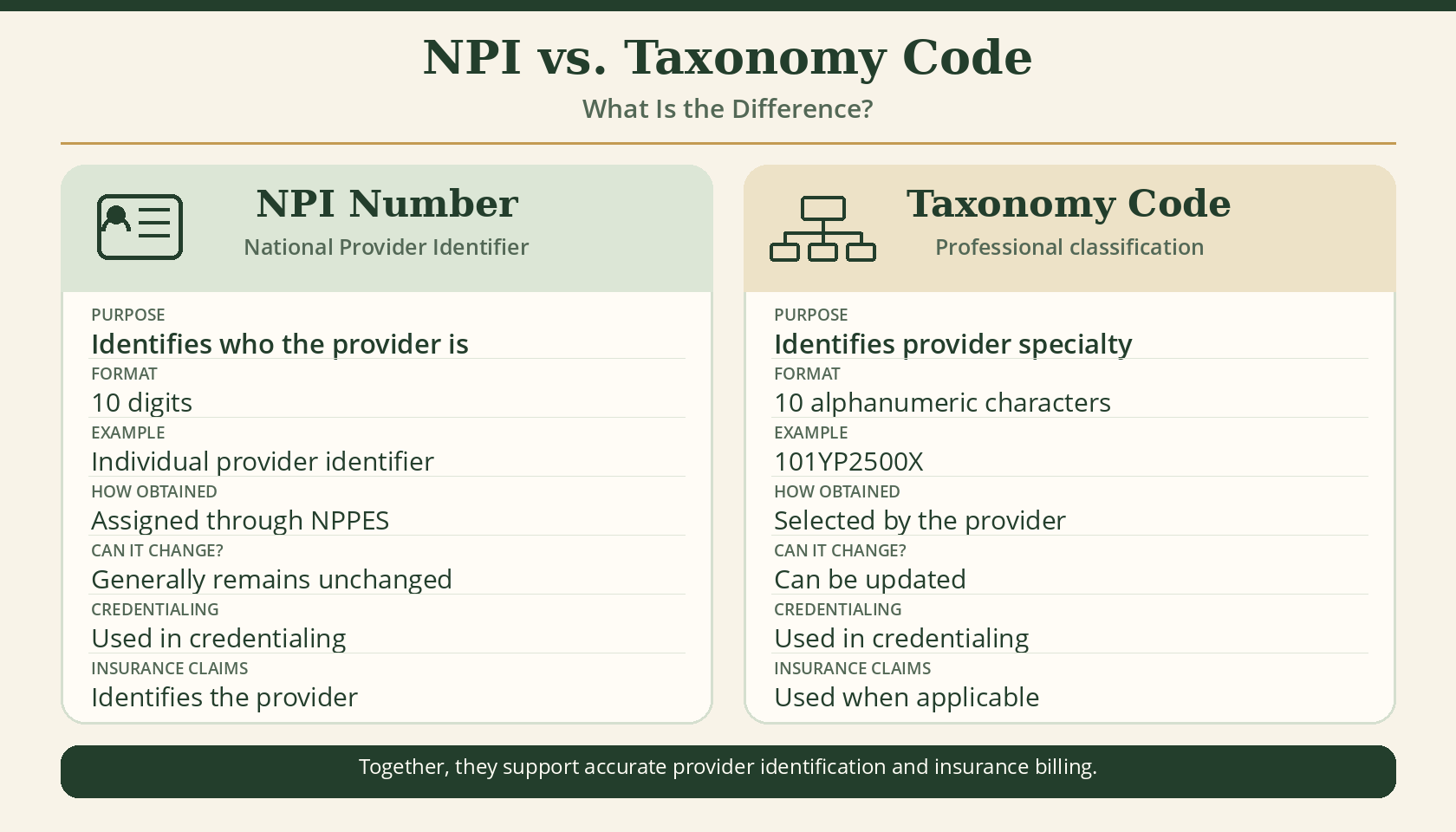
Neither identifier replaces a professional license, Taxpayer Identification Number (TIN), diagnosis code, or Current Procedural Terminology (CPT) code.
Common Taxonomy Codes for Mental Health Providers
The correct taxonomy code depends on the clinician's professional qualifications, education, training, and applicable classification. The following table provides frequently encountered taxonomy codes for mental health professionals.
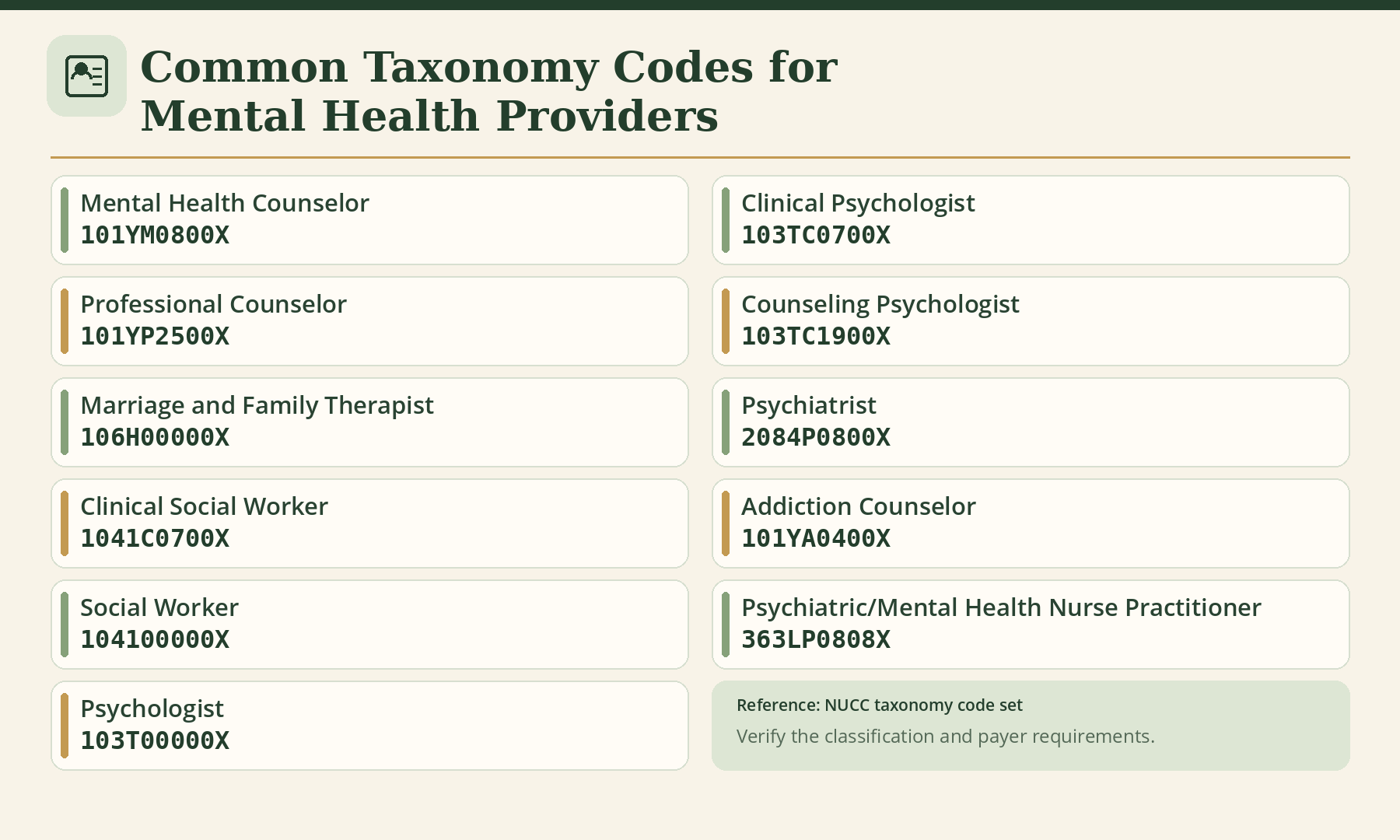
These codes are available through the official NUCC taxonomy code directory. Providers should verify the current classification and any payer-specific enrollment requirements before selecting a code.
What Is the Taxonomy Code for a Group Therapy Practice?
Eligible group practices may use organizational classifications, including the following:
Organizational classificationTaxonomy codeMulti-Specialty Group193200000XSingle Specialty Group193400000XMental Health Clinic/Center261QM0801X
A group practice should not automatically select a clinic or organizational taxonomy simply because it employs multiple therapists. The appropriate classification depends on the nature of the organization and its enrollment arrangements.
How to Select the Correct Taxonomy Code
Selecting a taxonomy code begins with identifying the professional classification that accurately represents the provider's qualifications. A therapist should review their license, education, professional designation, and current practice arrangements before comparing the available classifications in the official taxonomy directory.
Some professional titles vary between states. A counselor may encounter several related classifications, including general counselor, professional counselor, and mental health counselor. These should not be treated as automatically interchangeable.
Once the appropriate classification has been identified, the therapist should confirm that the insurance payer recognizes the classification for the requested enrollment arrangement. Selecting a different code solely to obtain reimbursement or bypass a credentialing restriction is not an appropriate solution.
For clinicians receiving newly independent licenses, the process may also involve reviewing existing provider records, as explained in the guide to transitioning from pre-licensed to fully licensed therapist insurance billing.
Can Therapists Have Multiple Taxonomy Codes?
Yes. Healthcare providers can register multiple applicable taxonomy codes under the same NPI, provided that one classification is designated as primary.
The additional classifications must accurately represent the provider's professional qualifications. Having multiple specialties does not require an individual therapist to obtain a separate Type 1 NPI for each specialty.
When a provider works with several insurance networks, the taxonomy required for a particular claim may depend on the classification recognized under that payer's enrollment records. The primary taxonomy listed in NPPES is not necessarily the classification every insurer requires for every transaction.
Maintaining multiple taxonomy codes is useful when professionally appropriate, but practices should avoid adding unrelated classifications without a legitimate reason.
Type 1 vs. Type 2 NPI for Therapists
Understanding the difference between individual and organizational NPIs is particularly important for group-practice owners and therapists who operate through separate business entities.
Type 1 NPI: Individual Providers
A Type 1 NPI identifies an individual healthcare professional. A therapist retains this identifier when providing services independently, joining a group practice, or changing employment arrangements.
Individual providers are generally eligible for one Type 1 NPI. A sole proprietor is also considered an individual for NPI purposes, even if they possess an Employer Identification Number (EIN).
Type 2 NPI: Organizational Providers
A Type 2 NPI identifies an eligible healthcare organization. A group therapy practice or qualifying incorporated healthcare business may obtain this identifier separately from the individual providers working within it.
When a group practice bills through an organizational arrangement, insurance claims commonly identify the organization as the billing provider and the individual clinician as the rendering provider.
Obtaining an organizational NPI does not automatically authorize every therapist within the practice to bill under the group's insurance agreements. Each clinician must satisfy applicable payer requirements for participation and affiliation. This distinction is particularly important when adding a therapist to an existing group insurance contract.
How to Find Your NPI and Taxonomy Code
Therapists can verify their registered provider information through the public NPPES NPI Registry.
Follow these steps:
Open the NPI Registry.
Search using the NPI number or provider name.
Select the correct individual or organizational record.
Review the registered taxonomy classifications.
Identify the primary taxonomy code.
The registry helps practices confirm provider identity and registered specialty information before submitting credentialing applications or configuring insurance billing software. However, the information displayed in the registry does not independently confirm insurance network participation or professional license status.
How to Update Your Taxonomy Code in NPPES
Therapists may need to update their taxonomy information following changes in professional classification, licensure, or qualifications.
The update can be completed through the NPPES portal by accessing the existing NPI record, reviewing the taxonomy section, adding or modifying applicable classifications, and submitting the updated information.
CMS requires covered healthcare providers to report changes to their NPI registration information within 30 days of the change.
After submitting an update, the practice should verify the revised NPI record and review the corresponding information maintained by CAQH, relevant insurance payers, and the billing platform. Updating NPPES alone does not automatically update every insurance company's enrollment records.
Similar administrative coordination may be necessary when changing a therapy practice name or DBA.
How Taxonomy Codes Affect Insurance Credentialing
Insurance companies use provider classification information as part of their credentialing and enrollment processes. The taxonomy code helps identify the professional category under which a clinician is applying to participate in an insurance network.
When the provider's taxonomy information conflicts with their license, application details, or existing payer records, the insurer may request clarification or supporting documentation. This can delay processing or create difficulties when claims are submitted after enrollment.
Practices should maintain accurate provider information across:
NPPES registration records
CAQH provider profiles
Insurance credentialing applications
Payer enrollment records
EHR and insurance billing settings
Accurate information does not eliminate every credentialing delay, but it reduces preventable administrative discrepancies. The broader process is explained in this guide to insurance credentialing for therapists.
Where Do Taxonomy Codes Appear on Insurance Claims?
Professional insurance claims submitted using the CMS-1500 form contain separate fields for rendering and billing provider identifiers. Taxonomy requirements depend on the payer and the corresponding claim format.
Claim fieldInformationBox 24J, unshadedRendering provider NPIBox 24J, shadedRendering provider taxonomy, when requiredBox 24I, shadedApplicable identifier qualifierBox 33ABilling provider NPIBox 33BBilling provider taxonomy, when required
The rendering provider generally identifies the individual associated with the service, whereas the billing provider identifies the individual or organization submitting the claim under the applicable enrollment arrangement.
Practices must verify the payer's requirements before submitting claims, particularly when billing through a group organization or under approved supervisory arrangements.
How to Configure NPI and Taxonomy Codes in SimplePractice
SimplePractice allows therapists and group practices to maintain separate clinical provider information and insurance billing settings. Ensuring these records correspond with payer enrollment information helps prevent incorrect identifiers from appearing on generated claims.
Configure the Rendering Provider Information
In SimplePractice, the clinician can review their individual information under Settings > Profile > Clinical info.
The rendering provider settings should include the appropriate individual NPI, professional credentials, and applicable taxonomy code. Group practices should coordinate with each clinician to verify their profile information.
Configure the Billing Provider Information
Under Settings > Client billing and insurance > Insurance billing, practices can review their billing provider information, including the billing NPI, taxonomy code, tax identification details, and billing address.
Group practices should confirm that the organizational details match the relevant payer enrollment arrangement. Where different payers or clinicians require specific configurations, SimplePractice also supports claim rules that can modify designated claim fields.
Before submitting claims, practices should inspect the generated claim details to ensure that the appropriate provider identifiers are being transmitted. Changes made within an EHR do not replace the need to update insurance enrollment records.
For practices requiring additional administrative support, SimplePractice billing services can help maintain organized billing workflows.
How to Resolve NPI and Taxonomy Code Mismatches
An incorrect taxonomy code or provider identifier can result in claim rejections, denials, or additional requests from insurance payers. The appropriate correction depends on where the discrepancy originated.
ProblemRecommended actionIncorrect taxonomy in NPPESReview and update the registered classificationOutdated CAQH informationUpdate the relevant provider profilePayer records contain outdated detailsSubmit a provider information correctionIncorrect rendering NPIReview individual clinician settingsIncorrect billing NPIVerify the approved billing arrangementMissing taxonomy on a claimConfirm payer-specific submission requirements
When a claim is rejected, the billing team should identify the reported error and determine which system needs correction. A claim that has already been processed and denied may require a different correction, resubmission, or appeal procedure.
Repeatedly submitting the same claim without addressing the underlying provider information can create additional administrative work. These discrepancies are among the common credentialing mistakes that delay therapist payments.
How HireGaynell Supports Therapists With NPI and Credentialing Administration
Maintaining provider records becomes increasingly time-consuming as a practice adds clinicians, joins insurance networks, or changes its billing arrangements. Small discrepancies between systems can remain unnoticed until an application stalls or an insurance claim is rejected.
HireGaynell provides insurance credentialing services for therapists, supporting administrative activities involving CAQH profiles, payer applications, provider enrollment, and credentialing follow-up.
New solo practitioners can also receive help with NPI registration, insurance setup, and administrative systems through practice launch support. Existing practices may benefit from ongoing billing administration or private practice consulting when reviewing their provider information and operational processes.
Final Thoughts
Accurate NPI and taxonomy information provides an important foundation for insurance credentialing, provider enrollment, and mental health billing. Therapists should review their professional classifications whenever relevant provider information changes and confirm that insurance records and billing configurations remain consistent.
For solo practitioners and group therapy practices, maintaining accurate provider identifiers can help prevent avoidable claim errors, reduce administrative delays, and support a more organized insurance billing process.
Frequently Asked Questions
What is the taxonomy code for a mental health counselor?
The Mental Health Counselor taxonomy code is 101YM0800X. The Professional Counselor classification uses 101YP2500X. The appropriate selection depends on the provider's professional classification and applicable enrollment requirements.
What is the taxonomy code for an LCSW?
The Clinical Social Worker taxonomy code is 1041C0700X. Providers should verify that their professional qualifications and insurance enrollment records correspond with this classification.
Can an incorrect taxonomy code cause an insurance claim denial?
Yes. Incorrect or missing taxonomy information can cause a claim rejection or denial when it conflicts with payer requirements or provider enrollment records.
Do therapists need a new NPI after becoming fully licensed?
Generally, no. An individual therapist normally keeps their existing Type 1 NPI and updates the associated professional information, including their taxonomy classification when appropriate.
Does updating NPPES automatically update insurance companies?
No. Updating an NPI record in NPPES does not automatically correct every insurance payer's enrollment information. Separate updates may be required through CAQH and individual payer systems.
Do private-pay therapists need an NPI?
The requirement depends on the provider's activities and applicable healthcare transaction requirements. Private-pay therapists may also use an NPI for superbills or other administrative purposes, even if they do not directly submit insurance claims.
