
Switching Mental Health Billing Companies: A Step-by-Step Checklist for Therapists
Switching mental health billing companies is a controlled transfer of responsibility for claims, payment posting, accounts receivable, payer follow-up, remittance records, and access to the systems that hold that work. The risk is not the act of hiring a new biller. The risk is ending one relationship before the practice knows which claims are still open, who owns them, which logins the outgoing team controls, and how payments will be reconciled after the cutover.
For a solo therapist or small group practice, a clean transition starts with visibility. The practice owner needs a record of open claims, unpaid insurance balances, recent remittances, denials, payer contacts, access permissions, and unresolved tasks before the outgoing biller leaves the workflow.
What Practices Need to Know First
A billing-company switch should not begin with cancelling access. It should begin with documenting unfinished work.
Before the old billing relationship ends, the practice needs a defined cutover date, a claim inventory, a named owner for old AR, confirmation of payer and EHR access, verification of ERA and EFT arrangements, and a plan for removing access after assigned work is complete. The transition succeeds when every unfinished billing task has one owner and enough documentation for another person to continue it.
What Matters Before You End the Current Billing Relationship
Do not treat the last day with the old biller as the first day of the transition. The handoff begins before notice, access removal, or a new claims workflow goes live.
Start by reading the current billing agreement. Look for the notice period, termination terms, ownership of records, post-termination work, fees tied to old claims, data-return language, and any clause describing what happens to accounts receivable after the relationship ends. Billing contracts differ, so a practice should use its own agreement as the controlling document and obtain legal review when a dispute or unclear obligation affects the handoff.
Then define the cutover in writing. A useful cutover plan answers four questions:
Which date separates old work from new work?
Who owns claims already submitted before that date?
Who handles claims for services already delivered but not yet submitted?
Who works denials, corrected claims, appeals, and unpaid balances that remain open after the cutover?
A practice that cannot answer those questions is not ready to remove the outgoing biller.
The staffing model also matters. A billing company, in-house employee, and specialized administrative professional do not always carry the same scope. The existing breakdown of virtual assistants handling insurance billing for therapy practices helps define which billing functions can sit inside administrative support and which require a broader revenue-cycle arrangement.

Build the Claim Inventory Before Access Changes
A billing transition should start from a claim-level inventory, not from memory. In SimplePractice, current insurance reports include unpaid insurance appointments, outstanding claims, filed claims, Payment Reports, and insurance status checks. Billing reports also show outstanding client and insurance balances. These reports can be exported for review and reconciliation.
The purpose of the export is not to create a second billing system in a spreadsheet. It creates a dated control record showing what existed at the handoff.
At minimum, record:
claim or appointment
payer
client account reference
date of service
billed amount
current status
last follow-up date
denial or rejection reason when present
next action
responsible person
Practices with a large unpaid balance should compare the transition list against a consistent process for working aging accounts receivable and unpaid claims. The incoming billing team needs to know which claims are merely pending and which ones are already moving toward a filing, correction, reconsideration, or appeal deadline.
Fee schedules deserve their own handoff file. A new biller can post payments without knowing the practice's contracted rates, but the practice loses an important financial control if no one can compare a remittance with the expected allowed amount. The existing breakdown of reading payer fee schedules and spotting payment differences provides the background needed for that comparison.
Do not delete or overwrite the original export after work starts. Keep the dated handoff copy so the practice can later determine which claims belonged to the old queue and which claims entered the system after the cutover.
Decide Who Owns Old Accounts Receivable
Open AR is where billing transitions become messy. The outgoing company may have submitted the original claim, the incoming company may inherit the follow-up, and the practice owner may assume both teams are watching the same balance.
That arrangement can produce the opposite result. No one acts because ownership is unclear.
Choose one responsibility rule and document it. A practice may divide work by date of service, original submission date, cutover date, payer, or a defined list of inherited claims. The correct rule is the one written into the transition arrangement and understood by everyone handling the queue.
For every open claim, assign one owner and one next action.
A claim should not sit in a shared category called “old billing.” Give it a real operational status:
payer processing
rejected and needs correction
denied and needs review
paid but not posted
waiting for records
waiting for payer response
corrected claim pending
appeal pending
closed
Unpaid claims and formal denials should also remain separate. An unpaid claim may still be processing or may need routine status follow-up. A denial has reached adjudication and requires action based on the payer's stated reason and the applicable deadline.
That distinction becomes especially important during a handoff. A new team inheriting 80 “unpaid claims” has a very different workload if 20 of them are actually denials with active response deadlines.
Keep EFT, ERA, and EHR Access Separate
Three controls often get blended together during a billing-company switch: the movement of money, the remittance record, and access to the practice-management system.
They are connected, but they are not the same process.
EFT — Electronic Funds Transfer — is the payment moving from the insurer to the provider. SimplePractice states that insurance funds are delivered by the payer outside SimplePractice. The platform does not control the actual transfer of insurance funds.
ERA — Electronic Remittance Advice — records how the payer processed the claim. SimplePractice calls these Payment Reports. When a practice is enrolled and the payer sends a Payment Report, the report can update claim information and record insurance payment data in the account.
EHR access controls what the billing person can see and do inside SimplePractice.
Changing billing companies does not automatically mean every payer needs new bank information. It does mean the practice should verify each payment route before assuming nothing changed.
Check:
which bank account receives EFT deposits
who controls the payer's EFT enrollment
where ERAs are delivered
which payer portals contain remittance information
which users can see Payment Reports
which person owns payer login recovery
which email receives payer notifications
A frequent transition mistake is assuming that “the biller handled it” means the practice controls it. Ownership needs to be verified.
SimplePractice's current Practice Biller role can manage billing information, payments, billing reports, insurance claims, and Payment Reports across the practice. A Practice Manager carries broader administrative authority, including access to settings, and can modify information connected to the practice's online-payments account.
That difference matters during onboarding. A billing contractor who needs to file claims and review remittances may not need the broadest administrative role available.
For practices using SimplePractice as the main billing environment, SimplePractice billing support for therapists shows how claims, payment posting, reconciliation, rejection follow-up, and account organization fit together inside the service model.
Remove Old Access Without Losing the Audit Trail
Shared credentials create unnecessary risk during a transition.
SimplePractice requires separate credentials for team members in group-practice accounts. Its documentation states that shared login credentials interfere with the HIPAA Audit Log and create security concerns. Account owners and authorized practice managers can manage roles and remove team members when access is no longer required.
Before removing an outgoing billing team, map every system that team used:
SimplePractice
payer portals
clearinghouse accounts
shared practice email
cloud storage
phone or fax systems
payment portals
billing spreadsheets
credentialing systems
password-management tools
Confirm who owns each account, which email address receives password resets, and who controls multi-factor authentication.
A practice should not learn after termination that an insurance portal is tied to a former contractor's phone number.
Access removal also needs to match the handoff agreement. An outgoing company may still have assigned work on a defined group of old claims. Removing all access before that work ends can create another operational failure.
Define the remaining task first. Define the access needed to complete it second. Remove the permission when the task no longer has a legitimate business purpose.
The same access discipline applies beyond billing. HireGaynell's resource on HIPAA-compliant administrative support for therapy practices covers the wider relationship between administrative delegation, protected information, user access, and practice responsibility.
Close the HIPAA Handoff, Not Just the Billing Handoff
A billing company that handles protected health information may act as a HIPAA business associate based on the services performed and the relationship with the practice.
HHS explains that covered entities and business associates generally use written business associate contracts defining permitted uses of PHI, safeguards, reporting duties, and termination obligations. HHS sample provisions state that PHI should be returned or destroyed at termination when feasible, subject to the agreement and limited circumstances involving continued legal responsibilities.
HHS also states that a business associate may not block a covered entity's access to PHI maintained on its behalf as a way to resolve a payment dispute. Electronic PHI must remain accessible and usable as required under the Security Rule.
For the practice owner, the administrative work includes:
reviewing the current Business Associate Agreement
identifying PHI held outside the EHR
confirming what data the old company maintains
documenting return or destruction requirements
removing unnecessary access
retaining proof of the completed handoff
A disagreement over contract rights, data possession, unpaid invoices, or termination obligations can require legal review. Billing administration should not be used as a substitute for legal interpretation when the parties disagree about contractual rights.
Reconcile the First Billing Cycle After the Switch
A transition is not finished when the new company files its first claim.
It is finished when the practice can trace claims, remittances, deposits, adjustments, and balances across the cutover without unexplained gaps.
During the first billing cycle, compare four records:
claims filed in the EHR
claim statuses returned by the payer or clearinghouse
Payment Reports or EOBs showing adjudication
actual deposits received in the practice bank account
SimplePractice's insurance reports include filed claims, outstanding claims, Payment Reports, and unpaid insurance appointments. Its billing reports include outstanding balances.
Those records answer different questions.
A paid claim confirms adjudication activity. It does not by itself confirm that the deposit reached the expected bank account, the client responsibility was recorded correctly, or the remaining balance matches the remittance.
The new billing team should investigate differences instead of carrying them forward into the next cycle.
Credentialing issues also deserve attention during this review. A new billing company cannot fix an inactive payer enrollment or incorrect provider record through routine claim follow-up. HireGaynell's discussion of credentialing mistakes that can surface as payment problems helps separate enrollment problems from claim-processing problems.
Coordination-of-benefits cases should remain visible as a separate queue. Secondary billing depends on the primary payer's adjudication information, so an inherited COB case can resemble an ordinary unpaid claim even though its next step depends on the primary remittance. The workflow for coordination of benefits in therapy billing covers that distinction in greater detail.
Ask a New Billing Company Questions That Expose the Workflow
A sales conversation should tell the practice how the company works after a claim stops moving normally.
Generic statements about experience or customer service do not answer that question.
Ask:
Who will own inherited AR?
What happens to denials already open on the cutover date?
How often are outstanding claims reviewed?
How are payer contacts documented?
How are reference numbers stored?
Which EHR permissions are required?
Which payer portals need access?
Does every staff member use an individual account?
How are Payment Reports reviewed?
How are insurance payments posted?
Who verifies EFT destination information?
What report will show all open claims at month-end?
How are corrected claims separated from formal appeals?
Who identifies credentialing problems?
Who handles benefit-verification errors found after billing?
How does the company return records at the end of the relationship?
Pay close attention to ownership.
“We handle denials” is less useful than knowing who reviews a denial, how it enters the work queue, what documentation gets attached, how the deadline is tracked, and how unresolved cases appear on a report.
A practice with documented workflows is easier to transfer between staff members or vendors. The existing resource on administrative SOPs for therapy practices explains how task ownership, triggers, and repeatable procedures reduce dependence on one person's memory.
Do Not Blame the Biller for an Upstream Practice Problem
Changing billing companies cannot repair every revenue-cycle problem.
Some failures begin before the billing company receives a claim.
Incorrect member information, incomplete benefit verification, authorization gaps, credentialing problems, incorrect payer records, and inconsistent intake data can create downstream billing work. A different company may process the same incorrect input faster and still reach the same denial.
Before changing vendors, identify the pattern.
Repeated eligibility or benefit problems point back toward the practice's insurance benefit verification process.
Provider enrollment, payer demographic errors, effective-date problems, or CAQH issues belong in credentialing. HireGaynell's insurance credentialing service for therapists covers the administrative work involved in payer applications, CAQH information, enrollment records, and follow-up.
Practices with recurring provider-data problems also need a defined owner for ongoing maintenance. The explanation of CAQH ProView re-attestation and profile maintenance provides a separate home for that process.
Finding the upstream source matters because a billing-company change can otherwise hide the original problem for another cycle. The new team starts with the same payer records, same client data, same credentialing status, and same incomplete workflow.
The vendor changed. The cause did not.
Solo Therapists and Group Practices Need Different Cutover Controls
A solo therapist may have fewer user accounts and a smaller claim queue, but that simplicity can create one major weakness: one person often holds all the institutional knowledge.
The owner may be the only person who knows:
which payers are active
which portals are used
which denials are unresolved
which EFT enrollments exist
which clients have recurring authorization issues
where contracts and fee schedules are stored
The priority is to move that knowledge out of memory and into the transition record before the old biller leaves.
A group practice faces a different problem. Open claims can span several clinicians, payer contracts, effective dates, enrollment records, and billing arrangements. The cutover inventory should be sortable by clinician and payer so one provider's problem does not get mistaken for a practice-wide billing failure.
Billing work also needs to remain distinct from provider enrollment. A group adding clinicians may still need separate work around getting therapists onto insurance panels even after the billing handoff is complete.
Some growing groups also reach a point at which claims are only one part of the administrative load. Intake, scheduling, provider onboarding, recurring communications, and operational maintenance may require ongoing practice administration support for group practices alongside billing.
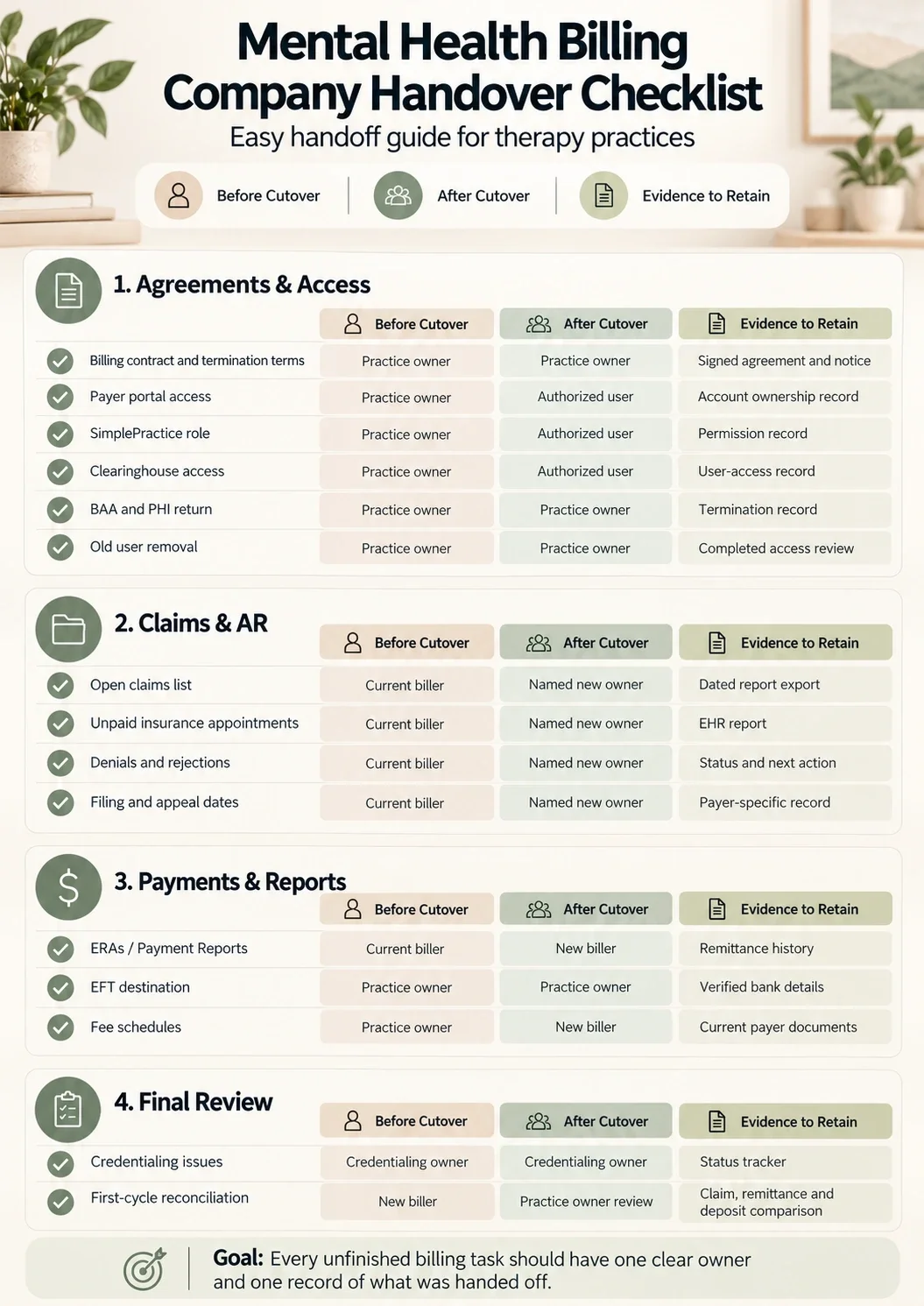
The handover sheet does not replace the payer's records, SimplePractice, contracts, remittances, or formal practice records. Its purpose is to prove what existed when responsibility changed and identify who owns every unfinished task.
A Full Billing Company Is Not the Only Transition Route
Some therapy practices need end-to-end revenue-cycle management. Others need a smaller amount of specialized billing administration inside the EHR they already use.
A solo therapist with a manageable payer mix, modest claim volume, clean provider enrollment, and organized intake may only need recurring claims work, posting, and follow-up.
A larger group with significant inherited AR, multiple clinicians, repeated denials, payer enrollment problems, and extensive reporting needs may require a broader billing operation.
A specialized mental-health virtual assistant can also sit between DIY billing and a full billing company when the work is administrative, the person's experience matches the workflow, and the practice keeps appropriate oversight. HireGaynell's mental health virtual assistant services for therapists include billing as part of broader behavioral-health administration.
A new solo practice has a different problem again. It may need the infrastructure built before there is any AR to inherit. Practice launch support for new solo therapists covers EHR setup, insurance portals, payer enrollment support, EFT setup, CAQH, and related administrative foundations.
The vendor's title does not decide the fit.
The deciding factors are the actual workload, payer mix, claim volume, open AR, EHR, required access, credentialing condition, reporting expectations, privacy controls, and the amount of responsibility the practice owner wants to retain.
What a Clean Billing Transition Looks Like
A clean switch leaves no mystery about old claims, access, money movement, or responsibility.
The outgoing biller has a defined endpoint. The incoming biller has a defined starting point. Open AR has a named owner. ERA and EFT are checked separately. SimplePractice access matches the assigned work. PHI handling is closed according to the applicable agreement. The first billing cycle is reconciled against real remittance records and actual deposits.
Changing mental health billing companies can correct a poor service relationship or create a billing model that fits the practice better. The move itself does not fix intake errors, credentialing problems, payer enrollment gaps, or poor internal controls.
The strongest transition starts by identifying the real problem, preserving the records needed to track it, and assigning every unfinished task before access changes.
Frequently Asked Questions
Can the old billing company keep working claims after the switch?
Yes, when the contract and transition arrangement allow it. Some practices leave defined pre-cutover claims with the outgoing company for a limited period. Others transfer the entire open AR queue to the incoming team. Put the responsibility rule in writing and give each claim one owner.
Do I need to change EFT when I change billing companies?
Not automatically. EFT controls the payer's transfer of funds to the provider. Confirm that each payer still sends funds to the correct practice-controlled account. Updates may be needed when the former company controlled part of the enrollment or account setup, but the requirement depends on the payer and the practice's current configuration.
Do I need to change ERA enrollment?
Verify it. ERA delivery is separate from EFT. In SimplePractice, Payment Reports are electronic remittance records showing how insurance claims were processed. Accepted enrollment can also support automatic payment recording in the account.
When should I remove the old biller's SimplePractice access?
Remove access when the person's assigned work no longer requires it and the practice has preserved the records needed for the handoff. SimplePractice supports individual team roles and team-member removal, so a shared login should not be used as a transition shortcut.
How far back should I export billing records?
There is no single national lookback period that fits every payer, contract, and practice. Export enough history to cover open claims, unresolved denials, active appeals, payment-posting questions, and contractual responsibilities. Formal record-retention obligations should be handled separately from the operational handoff file.
Can a new billing company fix old denials?
It may be able to work inherited denials when the contract permits it, the required records are available, and the applicable payer deadline remains open. Some problems cannot be corrected through billing alone. Enrollment status, credentialing, documentation, authorization, and contractual issues may require action from the practice, payer, clinician, or another specialist.
