
How to Bill Insurance for Pre-Licensed Therapists Under Supervision
Insurance billing for pre-licensed therapists under supervision depends on the clinician's legal authorization to practice, the insurance payer's policies, the supervising professional's credentials, and the information submitted on the claim. A therapist may be permitted to provide counseling or psychotherapy under clinical supervision without being eligible to bill every insurance plan independently.
Some commercial insurers reimburse eligible supervised services under specific arrangements. Medicaid requirements vary by state and program. Original Medicare has separate rules for independently enrolled mental health professionals and qualifying services provided under its incident-to requirements.
For therapy group-practice owners, licensed supervisors, practice managers, and behavioral-health billing administrators, the first task is establishing that the arrangement is permitted. The next is identifying the correct provider information, documenting the supervision relationship, and configuring the billing system to follow the payer's instructions.
Clinical supervision alone does not make a therapy session reimbursable. Insurance billing must reflect the service actually furnished, the professionals involved, and the rules applicable to the client's specific plan.
What Does Billing Under Supervision Mean for Pre-Licensed Therapists?
Billing under supervision refers to an insurance arrangement in which a clinician who has not yet obtained independent clinical licensure provides a service with the required oversight of an appropriately qualified supervisor.
The clinician may be working toward the supervised experience required for full professional licensure.
Depending on the state, these professionals may have titles including LPC Associate, LMFT Associate, licensed mental health counselor associate, clinical social work associate, registered intern, or another provisional designation.
Those titles do not have identical legal meanings nationwide.
A clinician can hold a valid associate-level or provisional license and still be considered pre-licensed for purposes of independent practice. Another individual may be permitted to provide specified services under an authorized institutional or training arrangement without holding the same type of individual credential.
The insurance payer may recognize one category but not another.
Clinical Permission and Insurance Eligibility Are Separate
State professional licensing rules establish the activities a clinician is authorized to perform.
Insurance coverage rules establish if and how the payer reimburses those services.
A state licensing board may permit an associate therapist to provide psychotherapy under an approved supervisor. That permission does not automatically require a commercial insurer to cover the associate's services.
The payer may require the supervisor to hold a qualifying license, maintain an active network relationship, and participate in a particular supervisory billing arrangement.
Some plans also require the associate to be identified or registered with the insurer.
The practice should establish both forms of authorization before describing supervised appointments as covered in-network care.
For organizations adding new clinicians, accurate insurance credentialing and provider enrollment administration supports the broader verification process. It does not substitute for the insurer's specific supervised-service policy.
Supervised Billing Is Not the Same as Independent Credentialing
Independent credentialing normally evaluates an eligible professional's qualifications for participation in an insurer's network.
An associate may not meet the payer's independent participation requirements, even when the clinician holds a valid provisional state credential.
A payer-approved supervised arrangement may instead rely on the supervisor, group practice, or another authorized billing structure.
That distinction matters because entering a supervisor's NPI into a claim is not equivalent to having an approved supervised billing arrangement.
The existing insurance credentialing process for therapists covers independent provider participation. Supervised billing addresses the additional conditions applying to services furnished by someone who has not reached that stage.
Can Pre-Licensed Therapists Bill Insurance?
Pre-licensed therapists can provide insurance-reimbursable services under some payer-approved supervisory arrangements, but there is no universal authorization across U.S. insurance plans.
The answer depends on the clinician's professional status, the supervising provider, the setting, the service furnished, and the applicable payer policy.
A group practice should not assume that a licensed supervisor's existing insurance contracts extend automatically to every associate the organization employs.
The Clinician's Exact Status Matters
Consider two individuals working toward independent counseling licensure.
One holds a state-issued associate license and practices under a board-approved clinical supervisor.
The other is a graduate student completing an educational internship.
A commercial insurer might permit services furnished by the associate under defined conditions without recognizing services furnished by the student.
That distinction reflects differences in professional authorization, training, employment arrangements, and payer policy.
The practice must determine which category applies before interpreting the insurer's rules.
A degree, an NPI, employment by a group practice, or a signed supervision agreement does not independently establish insurance eligibility.
The Supervisor's Network Relationship Matters
Some supervised billing policies require the supervising professional to be independently licensed and approved by the relevant payer.
The approval may involve individual credentialing, formal roster status, an organizational participation agreement, or another written authorization.
A supervisor's contract with one commercial network does not necessarily cover a different network operated by the same insurance company.
A practice should therefore confirm the precise network and plan.
Problems involving inconsistent provider enrollment records can surface later as claims denials. HireGaynell's resource on credentialing mistakes that delay therapist payments explains those broader record-matching issues.
The Four Approvals a Practice Needs Before Billing
A reliable supervised billing arrangement requires four separate checks before the practice submits claims.
Each check answers a question that the others cannot resolve.
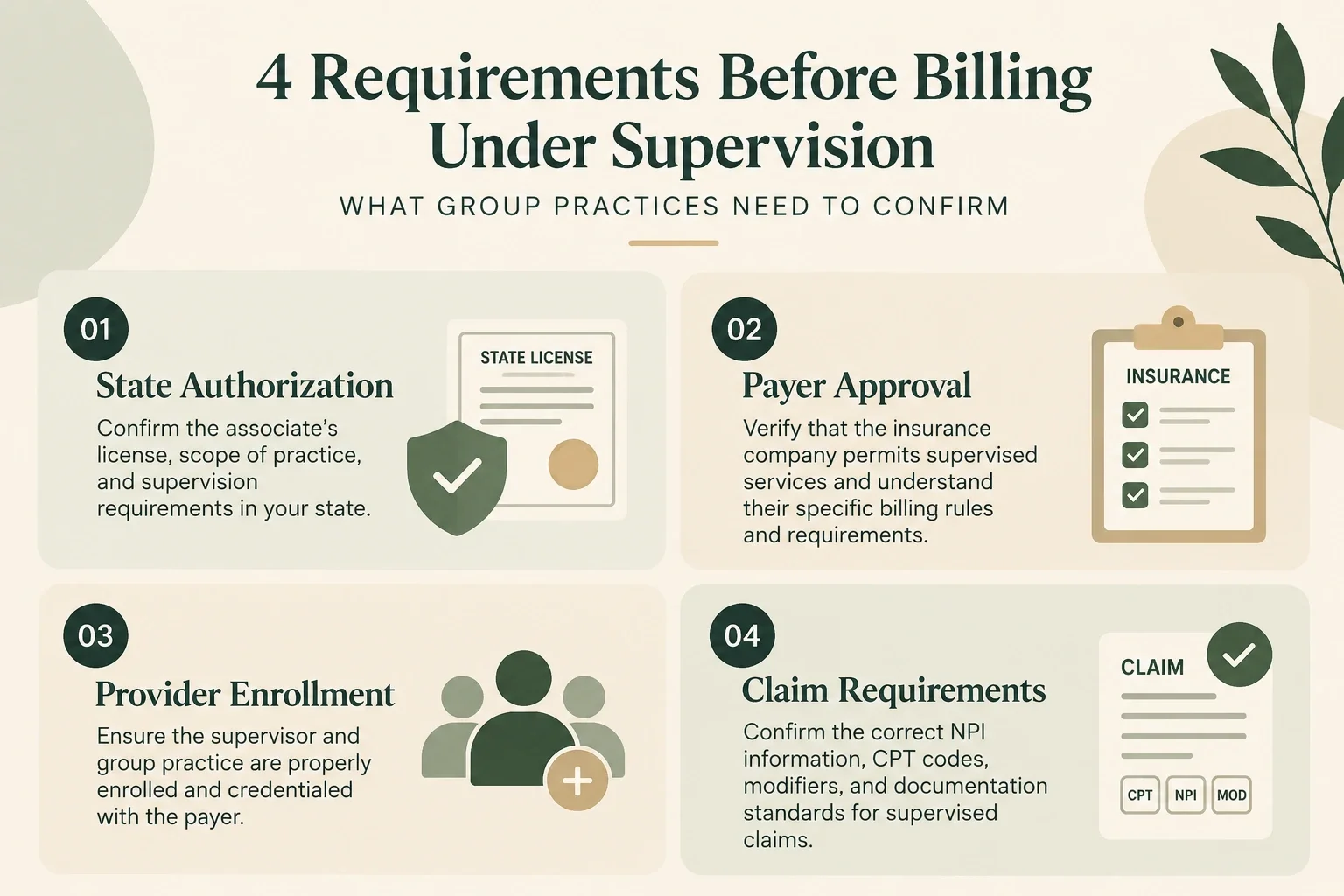
1. State Authorization to Deliver the Service
Confirm that the clinician's state credential and supervision arrangement permit the service being furnished.
Relevant requirements may address supervisor qualifications, supervision frequency, permitted practice settings, documentation, telehealth, and professional disclosures.
The clinical supervisor is responsible for maintaining the supervision relationship in accordance with the applicable professional rules.
An administrative employee can help track license documents and dates, but cannot determine a clinician's legal scope of practice independently.
2. Payer Authorization for the Supervised Arrangement
Obtain the insurer's current policy or written instructions identifying which pre-licensed clinician categories qualify.
The answer should establish the supervisor's required status, any practice or agency restrictions, and the way services must be identified on claims.
Verbal information can help identify the correct policy, but an unambiguous written confirmation is more useful when the practice later needs to explain its billing configuration.
The payer's authorization should be specific enough to distinguish a provisional counselor from a student trainee or another provider category.
3. Contracting and Provider-Record Approval
Establish that the organization and supervisor have the required participation or roster relationship.
For some arrangements, a fully executed group contract is necessary. For others, the insurer may recognize an independently participating supervisor.
The practice should confirm relevant effective dates and service locations.
Do not assume that a group Type 2 NPI automatically authorizes an associate's services.
A practice adding independently eligible clinicians should follow the separate insurance panel enrollment process. Associates working under supervision may require a different route.
4. Approval of the Claim Format
Confirm how the payer expects the billing provider, rendering provider, supervising provider, and any required modifiers to appear.
This is where technically correct clinical arrangements can fail administratively.
The insurer may accept supervised services but deny a claim because the supervisor's information is absent or placed incorrectly.
A practice should not interpret a clearinghouse's acceptance of the claim as confirmation that its supervised billing arrangement is permitted.
The clearinghouse may accept the file for transmission, leaving eligibility and policy decisions to the insurer.
How Commercial Insurance, Medicaid, and Medicare Rules Differ
Commercial insurance, Medicaid, and Medicare cannot be treated as one billing system for pre-licensed therapists.
They may recognize different professional categories, require different provider information, and apply different supervisory standards.
Commercial Insurance: Review the Actual Network Policy
Commercial plans can establish supervised-service requirements through contracts and provider policies.
Some permit particular associate-level behavioral-health services under an approved supervisor. Others require a different arrangement or do not cover the relevant pre-licensed clinician category.
One concrete example is the commercial supervisory-services guidance published by Optum.
Its September 2024 reference guide describes rules effective October 1, 2024, distinguishing arrangements in California, Colorado, Iowa, and Massachusetts from eligible arrangements in other states.
For the four identified states, the guidance addresses submissions from qualifying network and out-of-network providers or groups subject to applicable state requirements.
For other states, that published policy describes additional restrictions linked to existing participation agreements and written supervisory-service authorization.
These are payer-specific rules, not a national standard. The practice should confirm the current version, exact plan, and contracting arrangement before relying on them for a 2026 claim.
The same guidance identifies claim-level supervisor information and a U5 modifier for the covered arrangements.
These requirements provide a useful example of how detailed supervised billing can become, but the U5 modifier must not be added automatically to claims for unrelated insurance plans.
Medicaid: Rules Depend on the State and Program
Medicaid behavioral-health reimbursement depends on the applicable state program and service-delivery arrangement.
Some programs recognize services furnished by qualified associate-level or supervised professionals. Others establish different requirements for the rendering provider, supervisor, and enrolled organization.
The rules may also differ between a state fee-for-service program and a Medicaid managed care organization.
Even where a state permits a professional to practice under supervision, the payer may require a particular provider category, enrollment status, or billing arrangement.
An associate counselor working in a community behavioral-health agency may therefore face different rules from an associate in an independent outpatient group practice.
The relevant service setting matters.
The administrative distinctions between programs are discussed in HireGaynell's existing Medicaid enrollment resources. Supervised billing needs a more focused examination of the associate's eligibility and the applicable claim requirements.
Original Medicare: Independent Enrollment and Incident-To Are Different
Original Medicare generally requires mental health professionals seeking independent reimbursement to satisfy the qualifications applicable to their recognized Medicare provider category.
Since January 1, 2024, eligible marriage and family therapists and mental health counselors have been able to enroll and bill Medicare directly.
CMS requires qualifying education, state licensure or certification, and the specified postgraduate supervised clinical experience for those provider categories.
An individual still completing the experience required for that independent eligibility cannot assume that a provisional state credential permits direct Medicare billing.
Original Medicare also has a separate incident-to framework under which qualifying auxiliary personnel may furnish eligible services associated with a physician's or qualifying nonphysician practitioner's professional services.
CMS permits general supervision for eligible incident-to behavioral-health services under the applicable rules.
That does not mean every independently licensed therapist may bill Medicare for an associate's sessions by simply providing clinical supervision.
The incident-to requirements involve the eligible billing practitioner, the underlying professional service, setting, supervision, personnel, and other coverage conditions.
A group practice should not copy a commercial insurer's supervised billing setup into Medicare claims without independently establishing the applicable Medicare billing authority.
Medicare Advantage plans also require plan-specific review. Their obligations and billing arrangements should not be inferred automatically from a commercial network agreement.
Which Provider's NPI Goes on a Supervised Therapy Claim?
The correct National Provider Identifier depends on the payer's requirements and the role assigned to each provider in the approved arrangement.
The answer is not universally “use the supervisor's NPI.”
Professional claims contain different provider roles, and their meanings should not be confused.
Billing Provider
The billing provider identifies the individual or organization seeking payment.
In a group practice, the billing provider may be the organization associated with a Type 2 NPI.
In another approved arrangement, payment may be directed to an individually participating professional.
The practice's claim configuration must reflect its actual payer participation and payment arrangement.
Rendering Provider
The rendering-provider field identifies the provider represented to the payer as responsible for the service under the applicable claim rules.
For a standard independently licensed therapy claim, this normally corresponds to the clinician furnishing the service.
Supervised-service policies can impose specialized reporting instructions.
Some require the participating supervisor's name and credentials in the rendering-provider position. Other arrangements require information about the associate and supervisor to be reported differently.
Because payer specifications differ, the practice should confirm what the field represents under its particular supervised billing arrangement.
Entering a licensed person's NPI merely to obtain payment for an otherwise ineligible service is not acceptable.
Supervising Provider
Some payers require a separate supervising-provider identifier.
On the paper CMS-1500 form, certain arrangements use Box 17 and Box 17b to identify the supervisor. Other claim arrangements use different fields or electronic claim segments.
A payer may require both a specified rendering-provider configuration and a separate supervising-provider record.
The correct interpretation comes from the applicable claim instructions, not the presence of an available field in the billing software.
Why the NPI Does Not Establish Billing Eligibility
The National Provider Identifier is a healthcare identification number. It is not evidence that the insurer has credentialed the clinician or approved a specific supervisory arrangement.
An associate may obtain an NPI without becoming an independently participating insurance provider.
Similarly, a supervisor's established NPI does not automatically authorize payment for every service furnished under that person's oversight.
The payer must recognize the relevant provider relationship.
Payer-Specific Claim Requirements and Modifiers
A supervised psychotherapy claim needs to identify the covered service accurately and include any additional information required by the payer.
A normal psychotherapy CPT code does not independently communicate that the service was furnished by a pre-licensed associate.
The relevant payer may require additional provider details or a designated modifier.
What the Optum Supervisory Billing Example Teaches
The published Optum commercial supervisory-services reference guide identifies the DQ qualifier for a claim-level supervising provider and the U5 modifier for applicable supervised services.
The guidance describes the supervising clinician's name, credentials, and NPI in the specified claim fields.
For covered configurations, the reference identifies Box 17 for supervisory details and Box 17b for the NPI, with corresponding electronic claim information in the relevant 837P loop.
It also provides different examples for individual network providers, rostered groups, and other authorized organizational arrangements.
This distinction is important.
Even within one payer's policy, there may be more than one permitted configuration based on the contractual relationship.
A group practice should therefore identify its exact approved scenario before transferring that configuration into its EHR.
Do Not Add Supervision Modifiers Without Authorization
A claim modifier can convey information about a service or billing circumstance.
It cannot make an otherwise excluded service payable.
Adding U5, HO, or another code without establishing its applicability can produce an incorrect claim.
The sequence and combination of modifiers may also matter under an applicable payer policy.
For example, a virtual supervised session may involve both a supervision-related requirement and a separate telehealth billing requirement.
Those instructions need to be evaluated together.
The general psychotherapy coding framework in CPT codes used by therapy practices addresses coding the service itself. The supervisory rules determine the additional information required for the clinician arrangement.
Telehealth Supervision Needs a Separate Check
A therapist may have permission to provide in-person services under supervision without having an identical authorization for remote care.
The practice needs to verify state practice rules, the supervisor's required availability, client-location requirements, and the insurer's telehealth policy.
The payer may establish different billing instructions for the remote service.
A general statement that a supervisor is available by telephone should not be treated as sufficient for every licensing and payment arrangement.
The correct telehealth place-of-service and modifier rules belong to the specific plan and date of service.
HireGaynell's telehealth insurance billing resource covers that separate technical issue.
How to Set Up Supervised Billing in SimplePractice
SimplePractice supports supervision-related clinician settings and insurance claim configuration, but enabling those features does not establish authorization from the payer.
The practice should obtain the insurer's requirements before modifying billing information.
SimplePractice's official supervised-billing documentation, updated August 26, 2026, describes options for displaying the supervisor's credentials and appropriate provider information on claims.
Establish the Supervision Relationship in the EHR
The practice should begin by ensuring the associate and supervising clinician are identified correctly in the system.
The account's supported supervisor/supervisee settings can help preserve the relationship used in documentation review.
The underlying professional arrangement must already satisfy applicable licensing requirements.
Adding a supervisor's name to the EHR does not create the clinical supervision agreement required by a licensing board.
Check the Provider Configuration Before Claim Creation
The EHR needs the correct clinician status, supervisor information, NPI details, taxonomy information, and applicable billing-provider settings.
SimplePractice documentation explains that Box 24J can be configured differently according to the payer's requirements.
Its guidance also discusses circumstances in which the supervisor's identifiers populate relevant claim fields.
Those instructions are configuration options, not permission to misidentify the person who delivered care.
The practice should compare the resulting claim with the payer's written policy before using that configuration for active billing.
Recognize Platform Limitations
SimplePractice documents a specific restriction involving accounts with e-prescribing enabled: certain NPI fields are locked, preventing the same supervised-billing configuration approach.
The official guidance describes creating and downloading claims for submission outside the platform when that limitation applies.
An alternate submission method still needs to meet the payer's claim specifications.
It should not be used to bypass participation requirements.
For practices handling recurring claims, SimplePractice billing administration can support the operational work of claim preparation, monitoring, corrections, and payment tracking.
Verify a Sample Claim Before Using a Saved Configuration
A group practice may configure one associate's supervised claims differently from another clinician's standard independently licensed claims.
Before relying on saved settings, review a representative claim for the relevant payer.
Confirm the supervisor's information, organization details, codes, modifier requirements, and service location.
A successful configuration for one insurer should not be copied to every payer without verification.
The broader selection and configuration issues described in billing software for therapists become particularly important when a practice supports several clinicians with different participation arrangements.
Clinical Documentation and Supervisor Responsibilities
Insurance billing under supervision requires the clinical record to support the services provided and the approved supervisory relationship.
A submitted claim cannot make incomplete or inaccurate clinical documentation acceptable.
Supervisory arrangements may impose requirements beyond the ordinary progress note.
The Actual Treating Clinician Must Remain Identifiable
The client record should reflect who furnished the clinical service.
The documentation should be accurate regarding the clinician's professional status and the role of the supervising professional.
A supervisor reviewing or signing a note should not be represented as personally conducting the session when that did not occur.
Some payer-approved arrangements may use the supervisor's identifiers in specific claim positions. That does not change the underlying factual record of who provided treatment.
Record the Required Supervision
Applicable professional and payer rules may require documentation of the supervisor's qualifications, supervision relationship, reviews, and other activities.
A practice should determine what evidence each governing authority expects.
That might involve a formal agreement, recorded supervisory meetings, documented clinical oversight, signed note review, or other supporting records.
These requirements should not be assumed identical across clinical social work, counseling, psychology, and marriage and family therapy.
The supervising professional retains responsibility for clinical oversight within the legally applicable arrangement.
Clinical Signatures Must Reflect Actual Review
SimplePractice has features for supervisors to review and sign documentation connected to supervised clinicians.
The existence of a co-signature function does not mean every payer accepts every timing or signature arrangement.
The practice should define which notes require review, when approval must occur, and who is responsible for tracking completion.
Administrative staff may identify incomplete records, but they should not sign clinical documentation on behalf of a supervisor.
A payer audit may examine whether the recorded service and required supervision match the submitted claim.
The procedures in preparing therapy records for a payer audit address the broader documentation-review process.
Verify Client Benefits Before the First Supervised Session
A client's active insurance policy does not confirm coverage for services furnished by every clinician within a participating group.
The practice should verify the plan's behavioral-health coverage and the specific supervised billing arrangement before representing an appointment as in network.
This is particularly important when an intake coordinator schedules clients across multiple clinicians.
Verify the Provider Arrangement, Not Only the Member's Coverage
A basic eligibility response may confirm that the client has active coverage.
It may not establish that sessions delivered by a provisional therapist under a specific supervisor qualify for reimbursement.
The practice should ask the payer to confirm the associate category, supervisor eligibility, billing entity, and applicable service codes.
Authorization requirements and any restrictions on the service setting should also be checked.
The broader distinction between checking eligibility and verifying behavioral-health insurance benefits is important because supervised billing adds another coverage variable.
Communicate the Clinician's Status Accurately
Prospective clients should receive accurate information about the clinician delivering treatment and the applicable professional supervision.
The clinical practice should follow any state-required disclosures regarding associate or provisional status.
Financial discussions should distinguish confirmed coverage information from an estimate that remains subject to payer processing.
An intake coordinator should not describe a session as guaranteed to be covered simply because the supervisor appears in the insurer's provider directory.
The administrative intake workflow for therapy practices provides the wider scheduling context.
How Supervised Therapy Claims Move Through Billing
Once the clinical and payer arrangements are confirmed, the practice can organize the billing sequence around the actual appointment.
The goal is to prevent unsupported claims from entering the revenue cycle.
Before the Appointment
The practice confirms the associate's permitted scope, the supervisor's authorization, the client's relevant coverage, and the payer-approved claim arrangement.
The EHR must be configured with the correct provider information and any required payer-specific fields.
If the necessary authorization remains unresolved, the practice should not assume that the session can be submitted as an in-network supervised claim.
After the Appointment
The associate completes accurate clinical documentation.
The supervisor performs the oversight and review required by the governing arrangement.
The person responsible for billing confirms that documentation and relevant administrative conditions have been met before submitting the claim.
Billing staff should not alter clinical facts to make a claim appear eligible.
During Claim Submission
The claim includes the appropriate service, provider identities, billing information, and required supervision-related details.
A clearinghouse may accept the file for transmission, but that acceptance does not guarantee reimbursement.
The insurer still evaluates coverage, participation, claim information, and relevant payment rules.
After Adjudication
The practice reviews the remittance, records appropriate insurance and client payments, and investigates discrepancies.
If the claim is rejected, denied, or underpaid, the reason should be established before submitting further transactions.
A claim submitted with an incorrect provider identifier may require a different correction process from a claim denied because the underlying service arrangement was not covered.
The accounts-receivable workflow should distinguish these causes.
Why Insurance Claims for Associates Get Denied
Supervised therapy claims can fail for eligibility, provider-enrollment, documentation, and claim-format reasons.
Different causes require different responses.
The Payer Does Not Recognize the Associate's Status
The plan may exclude the applicable pre-licensed provider category or require approval the practice has not obtained.
Changing the modifier or substituting a supervisor's NPI cannot make an excluded service eligible.
The practice should verify the payer's explanation before attempting further billing.
The Supervisor or Group Is Not Properly Recognized
A clinician may be independently licensed and serving as a legitimate clinical supervisor but lack the relevant payer enrollment or authorization required for supervised billing.
The practice could also have an organizational contract that does not cover the arrangement.
Correcting those enrollment records may require action outside the claim-submission system.
The Claim Uses the Wrong Provider Fields
The payer may require the supervisor in a specific claim field or electronic transaction segment.
A missing supervisory identifier, incorrect billing-provider combination, or inappropriate modifier can interfere with processing.
The correction must follow the relevant insurer's instructions for the original claim status.
Documentation Does Not Support the Billed Arrangement
The clinical record may not identify the treating clinician clearly, document the required supervision, or contain the applicable review evidence.
The practice should investigate the actual documentation requirements and existing records.
Creating supervision records after the fact to imply activities occurred when they did not is not an acceptable correction.
Rejection and Denial Require Different Responses
A rejected claim generally has not passed the initial acceptance process. The practice may need to correct the data and resubmit through the required route.
A denied claim has been adjudicated and may require a reconsideration, appeal, or other payer-defined procedure.
The correct approach depends on the payer's decision and the original transaction.
When a service is genuinely covered but the payer applies its policy incorrectly, the documented insurance claim appeal process for therapists may be relevant.
An appeal should not claim the service was eligible without the supporting facts.
What Happens When a Therapist Becomes Fully Licensed?
The transition from associate-level practice to independent licensure can change the clinician's insurance billing status.
It does not automatically change existing contracts or the way previously delivered services should be billed.
A new independent license may make the clinician eligible to apply for direct participation with insurers.
The payer still controls its credentialing and enrollment requirements.
Independent Licensure Requires a New Participation Review
Once the clinician meets the relevant licensing conditions, the practice can determine which insurer applications and enrollment updates are needed.
The clinician may need a new or updated CAQH profile, payer application, group affiliation, and participation agreement.
The applicable effective date matters.
A new license does not automatically make earlier supervised services independently billable.
The administrative details around maintaining CAQH provider records support the transition when the payer uses that credentialing information.
Do Not Change Existing Claims Retroactively Without Authorization
A session delivered during the associate's approved supervised period should remain documented according to the arrangement in effect on that date.
The subsequent achievement of independent licensure does not change who performed the earlier service.
Pending claims, payer remittances, and any required corrections need to follow the original service dates and applicable rules.
For future sessions, the billing configuration can change once the required independent participation and effective date are confirmed.
Update the Practice's Scheduling and Provider Records
Group practices should review clinician profiles, network directories, EHR settings, and financial information during the transition.
Intake staff need to know which plans the clinician participates in independently and which supervised arrangements have ended.
A practice should maintain the original records for the previously approved supervisory period.
Updating provider information without coordinating payer and EHR records can create avoidable claim mismatches.
Financial Risks for Group Practices Employing Associates
A group practice that employs pre-licensed therapists may increase its capacity to provide care, but the administrative complexity can also increase.
The business needs to understand which sessions are eligible for insurance reimbursement before basing staffing decisions on projected payer revenue.
Not Every Scheduled Appointment Represents Collectible Insurance Revenue
An associate may be clinically authorized to see a client but not eligible for reimbursement under that client's insurance plan.
If the practice assumes coverage incorrectly, several sessions can occur before the first denial identifies the problem.
The resulting financial exposure depends on the services, payer rules, and contract.
It should not be assumed that the practice can transfer the entire unpaid balance to the client after a claim is denied.
Participating provider agreements and applicable law may restrict balance billing or impose responsibilities on the provider when authorization was not established.
Repeated Claim Errors Can Produce Recovery Demands
A payer may initially reimburse supervised claims and later determine that the submitted arrangement did not satisfy its requirements.
That may lead to post-payment review, refund requests, or other actions permitted by the governing policy.
The financial exposure can involve a series of claims that used the same incorrect billing configuration.
For this reason, the first paid claim is useful evidence that the claim processed, but it does not conclusively establish that the arrangement will withstand an audit.
Revenue Sharing and Clinician Compensation Are Separate
An associate therapist may receive wages or compensation according to an approved employment or contractor arrangement.
The insurer's payment to the participating provider or organization does not automatically establish the associate's compensation.
Group-practice owners should keep reimbursement, payroll administration, professional supervision, and clinical responsibilities appropriately separated.
Financial arrangements must remain consistent with applicable employment laws, contractual requirements, and professional rules.
Who Should Manage the Supervised Billing Workflow?
Supervised insurance billing involves clinical, administrative, and payer-controlled responsibilities that should not be assigned to a single person indiscriminately.
The supervising clinician remains responsible for professional clinical oversight under the applicable rules.
The practice owner or authorized representative remains responsible for appropriate contractual and business decisions.
Billing administrators can support the operational process.
Clinical Responsibilities
Qualified clinical professionals establish the supervision relationship, verify the associate's permitted scope, determine clinical treatment, and complete required supervision and documentation.
Administrative staff should not make clinical decisions about the suitability of an associate for a particular treatment service.
Billing and Payer Responsibilities
A billing professional can organize payer policies, maintain approved claim configurations, review submission requirements, track claim status, and reconcile payments.
The insurer remains responsible for making coverage and adjudication decisions under the applicable plan and contract.
A billing administrator should document uncertainty and refer payer-policy questions to the appropriate department before claims are submitted.
Practice Management Responsibilities
A practice manager can maintain a record showing each associate, supervisor, professional status, applicable plans, approved billing arrangement, and administrative review dates.
Such a record should be updated when a clinician's license changes, a supervisor departs, or an insurer revises its policy.
A documented administrative SOP for therapy practices helps establish who checks these changes and when they affect scheduled appointments.
For group practices managing several clinicians, practice administration support may help organize non-clinical records and recurring tasks.
Privacy and Access Boundaries
A person responsible for claim submission may need access to insurance information and financial records without needing unrestricted access to psychotherapy notes.
The practice should configure role-based permissions according to the tasks assigned.
Applicable HIPAA obligations, business associate arrangements, and security procedures should be considered when an external billing service or virtual assistant handles protected health information.
The separate requirements for HIPAA-related administrative support are relevant to that access arrangement.
When Insurance Billing Under Supervision Is Not Available
Some pre-licensed clinicians cannot bill a particular insurance plan under their existing supervision arrangement.
That situation may arise because the payer does not recognize the clinician category, the required supervisor participation is missing, or the state practice arrangement does not meet the plan's conditions.
The practice should establish the reason before deciding how to proceed.
A Licensed Clinician May Need to Provide the Service
If the payer covers services delivered by an independently licensed professional but not the associate, an appropriately qualified and participating clinician may need to furnish the service.
The practice cannot solve the restriction by placing that clinician's name on a claim for a session they did not provide unless the payer has expressly authorized the applicable supervised arrangement.
Clinical assignment decisions should reflect the client's needs and relevant professional responsibilities.
Private Pay Requires Its Own Review
Private pay may be a possible arrangement for some pre-licensed clinicians in permitted settings, but it is not an automatic alternative to denied insurance billing.
State licensing rules determine if the clinician may furnish the service under the proposed arrangement.
Existing provider contracts, Medicare or Medicaid program requirements, and applicable client-protection laws can restrict direct payment for covered services.
The practice should communicate payment responsibilities clearly before treatment and should not assume that an excluded insurer claim can simply become a collectible client balance.
Smaller Practices May Not Need a Supervised Billing Program
A solo therapist who is already independently licensed and sees clients personally may not need this additional operational structure.
A group practice with only independently credentialed clinicians may also have no supervised billing arrangements to maintain.
The administrative workload becomes relevant when the organization actually employs or contracts with professionals delivering eligible services under approved supervision.
HireGaynell's mental health virtual assistant services address non-clinical coordination, while professional supervision and payer authorization remain separate responsibilities.
The Practical Standard for Billing Pre-Licensed Therapy Services
The safest administrative approach is to establish four facts before insurance billing begins: the clinician is authorized to provide the service, the supervision relationship meets the applicable requirements, the payer recognizes the arrangement, and the claim accurately represents the service under that payer's rules.
For group practices, a written payer-specific record makes the process easier to manage when several associates and supervisors have different professional statuses and network relationships.
That record should remain current through changes in supervision, licensure, provider affiliation, service location, and insurance policy.
SimplePractice and other billing systems can help apply approved configurations, but they cannot establish coverage or override an insurer's requirements.
The practical value of a supervised billing process lies in obtaining authorization first, documenting clinical responsibilities accurately, and maintaining enough visibility to identify errors before they affect an entire caseload.
Frequently Asked Questions
Can an LPC Associate bill insurance under supervision?
An LPC Associate may be able to provide reimbursable services under an approved supervisory arrangement, depending on the state's licensing rules and the client's insurance plan. Some payers recognize specific associate-level categories under defined conditions. The practice must confirm the payer's claim requirements and the supervisor's eligibility before billing.
Can an LMFT Associate bill insurance?
An LMFT Associate may qualify for supervised-service reimbursement under certain payer and state arrangements. An associate license does not automatically establish independent insurance participation. The payer may require approval of the supervising professional, group practice, or another specific billing structure.
Can a pre-licensed clinical social worker bill insurance?
Some insurers and Medicaid programs permit services furnished by social work associates or other approved supervised professionals. The applicable designation, authorization, and billing method depend on the state and payer. A professional working toward independent clinical social work licensure should not assume that all insurers recognize the same arrangement.
Can therapists use a supervisor's NPI to bill insurance?
Only when the applicable payer policy authorizes the specific arrangement and requires or permits the supervisor's information in the relevant claim fields. Using a supervisor's NPI without authorization can misrepresent the provider relationship. The clinician who actually furnished treatment must remain accurately documented.
Do pre-licensed therapists need their own NPI?
The need for an individual NPI depends on the clinician's applicable identification and enrollment requirements. Obtaining an NPI does not establish independent licensure or insurance eligibility. The practice should confirm its state and payer requirements before deciding which identifiers belong on supervised claims.
Is billing under supervision the same as incident-to billing?
Not necessarily. Commercial insurers sometimes use incident-to terminology for supervised services, but Medicare incident-to billing has its own federal requirements. A commercial supervised billing policy should not be applied automatically to Medicare claims, and a Medicare incident-to arrangement does not establish permission under a commercial insurance contract.
Does Medicare cover therapy provided by pre-licensed associates?
Original Medicare's recognized independent mental-health provider categories have specific qualifications. CMS also permits qualifying behavioral-health services under a separate incident-to framework involving eligible billing practitioners and auxiliary personnel. A standard licensure supervisor relationship alone does not establish Medicare billing eligibility.
What modifier is used for therapy provided under supervision?
There is no universal supervised-therapy modifier for every payer. Certain commercial supervised-service arrangements require U5, but the applicable code and claim configuration depend on the insurer, network, state, and service. Using a modifier without confirming payer authorization can create an incorrect claim.
Does a supervisor have to sign every associate therapy note?
The applicable clinical documentation requirements depend on state supervision rules, professional standards, and payer policies. Some arrangements require supervisor review or co-signature under specified conditions. The practice should establish the actual requirements instead of assuming that the same signature procedure applies to every clinician and insurer.
What happens to claims after an associate becomes fully licensed?
Services delivered before independent licensure must remain accurately documented and billed according to the rules applicable on their dates of service. Future claims may use a new independent provider arrangement once the payer's credentialing, contracting, and effective-date requirements are satisfied. Licensure alone does not automatically activate a new insurance contract.
