
How to Negotiate Insurance Reimbursement Rates for Therapists
Therapists can negotiate insurance reimbursement rates by reviewing their existing payer agreements, identifying the services that need higher reimbursement, preparing evidence of their practice's value, and submitting a documented rate-review request to the insurer's contracting department. The insurer evaluates the request under its own contracting procedures and may approve an increase, offer different terms, or decline to change the agreement.
A therapist's current reimbursement rate is not necessarily permanent. Some commercial insurance contracts allow individual rate reviews, whereas other networks follow more standardized payment arrangements. The practice needs to establish which rules apply before assuming that a rate increase is available.
For licensed professional counselors, clinical social workers, marriage and family therapists, psychologists, psychiatrists, and group-practice owners, reimbursement negotiations involve more than requesting additional money. The practice must establish which rates are financially sustainable, demonstrate its contribution to the insurer's network, and understand the contractual consequences of accepting revised terms.
A successful request also requires follow-through. Even after a payer approves new reimbursement amounts, the practice needs written confirmation, an effective date, and a reliable process for checking that subsequent claims are adjudicated under the correct agreement.
Can Therapists Negotiate Insurance Reimbursement Rates?
Therapists can request higher reimbursement rates from commercial insurance companies, but insurers are not required to approve every request. The opportunity depends on the participation agreement, payer contracting policies, regional network needs, and the provider's circumstances.
An established therapist may request a review after several years of participation under unchanged reimbursement terms. A clinician joining a new insurance panel may also ask about reimbursement before accepting a proposed contract.
The two situations are different.
An existing network provider already has an agreement that governs reimbursement. A new applicant is evaluating the contract before entering the network. Each situation may involve different decision-makers, documents, and opportunities for negotiation.
Some insurers maintain standardized reimbursement schedules for particular provider types or geographic areas. Others may consider provider-specific amendments when the circumstances justify a separate review.
For example, a psychologist offering a specialized assessment service in an area with limited provider availability may have a different contracting situation from a therapist providing general outpatient psychotherapy in a market with extensive network participation.
Those differences may influence a payer's assessment, but they do not establish an entitlement to higher reimbursement.
A Rate Negotiation Is Not an Insurance Claim Appeal
A reimbursement negotiation requests a change to the amount the payer agrees to allow for future covered services. An underpayment dispute addresses a claim that was processed below the amount required by an existing agreement.
If a therapist's contract allows $120 for a covered service and the payer incorrectly processes the claim using $105, the problem concerns the current contractual rate.
The practice should investigate the payment discrepancy through the applicable claim or contract-resolution process.
If the payer correctly processes the service at the agreed $120 but the therapist wants the future allowed amount increased to $135, that is a reimbursement negotiation.
These problems require different documentation and may be handled by different payer departments.
The process of identifying incorrect payments in a payer fee schedule belongs to the existing-contract verification stage. Negotiation begins when the practice has established that the current contractual amount itself needs review.
Check Your Contract Before Requesting Higher Rates
The participating provider agreement determines which reimbursement terms apply and how contractual changes must be handled.
Before contacting the payer, establish the current agreement, any amendments, and the fee schedule associated with the clinician or organization.
A practice may have contracts involving several networks administered by the same insurance company. It should not assume that one contracting request applies to every product.
Identify the Applicable Contracting Entity
The rate-review request needs to identify the provider and contractual relationship accurately.
Relevant information can include:
The practice's legal name and tax identification number.
The individual clinician's Type 1 National Provider Identifier (NPI).
The organization's Type 2 NPI when applicable.
The participating payer and network.
The agreement or contract identification number.
The contracted service location and applicable provider classification.
The current fee schedule and effective date.
These details matter because a provider may participate individually, through a group agreement, or through an intermediary network arrangement.
The organization responsible for negotiating the rates may not be the same organization whose name appears on the client's insurance card.
A practice using a delegated behavioral-health network should confirm which contracting entity controls its reimbursement terms.
Review the Clauses That Affect Negotiation
The most relevant contract provisions include the reimbursement methodology, amendment procedures, renewal terms, termination conditions, and applicable notice requirements.
Some agreements establish fixed reimbursement amounts for individual procedure codes. Others reference a percentage of a published fee schedule or another defined payment methodology.
A contract may also specify how changes become effective and which party must approve them.
The practice should identify the requirements applicable to the agreement it actually signed. A renewal date does not automatically provide a right to renegotiate, and an insurer may consider a request outside the renewal period.
The American Medical Association's payer-contracting resources emphasize that providers should review the full contract, including plan participation, payment methodology, amendments, and dispute terms.
For a therapist still entering insurance networks, provider credentialing and payer enrollment are related but separate administrative responsibilities. Credentialing approval does not itself establish a new reimbursement amount.
Identify Which Reimbursement Rates Need Negotiation
A rate request should concentrate on the services that materially affect practice revenue.
Asking an insurer to increase every rate by an arbitrary percentage can make it difficult to explain the financial basis of the request.
A better starting point is the practice's actual service mix.
Review the Services You Bill Most Frequently
For many outpatient therapy practices, relevant Current Procedural Terminology (CPT) codes include:
90791: Psychiatric diagnostic evaluation without medical services.
90832: Individual psychotherapy associated with the shorter time-based service.
90834: Individual psychotherapy associated with the intermediate time-based service.
90837: Individual psychotherapy associated with the longer time-based service.
90847: Family psychotherapy with the patient present.
90853: Group psychotherapy.
These codes do not apply to every clinician or service.
Psychologists offering psychological testing and psychiatrists providing evaluation and medication-management services may have different codes and reimbursement structures.
The practice should prioritize services actually furnished and documented within the clinician's professional scope.
The detailed differences between common psychotherapy codes are addressed in CPT codes used by therapy practices.
Avoid Using a Public Session Fee as the Entire Basis
A therapist may charge $175 for private-pay psychotherapy and receive a contractual allowed amount of $115 from an insurance network.
That difference alone does not demonstrate that the insurer should increase its rate to $175.
Private-pay fees and negotiated insurance amounts operate under different financial arrangements.
A stronger argument considers the cost of delivering the service, the practice's appointment utilization, payer-specific revenue, and the value of maintaining the provider within the network.
These factors help the clinician evaluate the business case. They do not establish a mandatory reimbursement standard for the insurer.
Build a Financial Case Using Actual Practice Data
A rate negotiation becomes more useful when the practice can show how its existing agreement performs financially.
Begin with a defined review period, ideally long enough to reflect ordinary variations in caseload and scheduling.
The information should come from the practice's own records, not assumptions about typical reimbursement or income.
Calculate Revenue by Payer and Service
Review the number of completed sessions, the contracted allowed amounts, and the collections associated with each payer.
A useful internal analysis identifies:
Total completed sessions under the payer's network.
The CPT codes responsible for most of that volume.
Total allowed amounts and actual collections.
The insurer's portion and applicable client responsibility.
Rejected, denied, and unpaid claims requiring additional work.
Administrative time associated with the payer.
Changes in operating costs since the current contract began.
The practice should not describe the insurer's payment alone as total reimbursement when the allowed amount includes deductible, copay, or coinsurance responsibility.
Separating those figures prevents inflated or misleading comparisons.
If a practice has recurring claims that remain unresolved, the additional work associated with insurance billing delays contributes to its administrative costs. Those expenses belong in the financial evaluation, even when they are not included in the contracted fee schedule.
Calculate the Effect of a Proposed Increase
A hypothetical example shows how a therapist can evaluate the financial significance of a requested adjustment.
Suppose the practice currently receives a $110 allowed amount for a particular covered service and requests an increase to $125.
The proposed difference is $15 per attended and payable session.
At 500 such sessions during a year, the potential increase in allowed revenue is $7,500, assuming the same service mix, reimbursement terms, and successfully collected balances.
This is an illustrative calculation, not an expected payer offer or a prediction of additional income.
It does not account for changes in appointment volume, client cost sharing, collection losses, or operating expenses.
The calculation still helps the therapist understand how much a proposed adjustment matters to the practice.
Determine the Lowest Sustainable Rate
A therapist should understand the financial amount needed to operate the practice sustainably before negotiating.
That assessment includes clinician compensation, administrative expenses, technology, professional costs, and the number of appointments that can realistically be completed.
A rate that covers direct clinical time but fails to account for unpaid administrative work may be difficult to sustain.
For group practices, the calculation should also reflect clinician compensation arrangements and organization-level costs.
The financially sustainable amount is an internal decision threshold. It is not proof that a payer is obligated to offer it.
When reviewing the data, therapy billing software and financial reporting can support the collection of claims, payments, and outstanding-balance information. The software still requires accurate provider and payer records.
Establish the Value Your Practice Provides to the Payer
A reimbursement request should explain why the insurer may have a reason to maintain or expand its relationship with the clinician.
Commercial insurers maintain provider networks to give covered members access to appropriate services.
A therapist can therefore explain the services and access their practice provides, using information that is accurate and supported by their own records.
Demonstrate Access to Care
Network access may be particularly relevant when the therapist serves a population with limited available providers.
Examples include a clinician offering appointments in an underserved rural community, a practice providing services in a language needed by local members, or a qualified professional treating a population with limited specialist availability.
A therapist may also offer appointment times that improve access for working adults or families.
These characteristics should be described accurately.
A claim that the therapist is the only available provider in a region requires evidence. A practice should not invent local network shortages or imply that all competing clinicians lack appropriate qualifications.
Public provider directories can offer some context, but they may contain outdated information.
Explain Specialty and Professional Qualifications
Relevant qualifications may strengthen the practice's contracting case when they support services needed by the network.
The therapist may document advanced clinical training, a clearly defined specialty, or relevant professional experience.
For psychologists, specialized psychological assessment services may have different network implications from routine outpatient psychotherapy.
For psychiatrists, evaluation and medication-management availability may present a distinct contracting consideration.
The payer must evaluate these circumstances under its own policies.
The practice should avoid promising clinical results or presenting certifications as proof of superior outcomes.
Use Actual Appointment Availability and Utilization
A practice can establish its service capacity using operational records.
Relevant measures may include existing appointment availability, the number of insurer members receiving care, and the time between an accepted inquiry and the first available appointment.
These are stronger when supported by a consistent reporting process.
A group practice might document that several licensed clinicians offer appointments in a geographic area where an insurer is expanding its network.
A solo therapist might document the number of existing members served and the availability of a specialized service.
The business argument should remain limited to evidence the practice can substantiate.
The accuracy of insurance provider directory listings also matters because the payer may rely on those records when assessing participation and service locations.
Distinguish Practice Value From Unsupported Performance Claims
Retention, attendance, and appointment access can help describe the administrative operation.
Clinical outcomes require greater care.
A therapist should not claim that treatment has reduced insurer expenses or improved clinical outcomes without reliable evidence and an appropriate basis for comparison.
Individual patient information should not be included in an ordinary contracting request when aggregate, non-identifiable data is sufficient.
The strongest case is a precise explanation of the provider's service capacity, clinical qualifications, and documented network participation.
Determine When to Request a Rate Review
The appropriate timing depends on the insurer's contracting procedures and the provisions of the participating agreement.
There is no universal rule requiring all therapists to wait a particular number of months or years before requesting higher reimbursement.
A practice should verify its specific contract before setting a negotiation schedule.
Before Signing a New Agreement
A therapist receiving an initial contract offer can review the proposed reimbursement terms before signing.
The practice should identify the offered rates, the networks included, the clinician's eligible services, and any terms that affect future revisions.
The appropriate contracting contact can explain if the proposed rates are subject to individual review.
If the agreement is not financially sustainable, the therapist should evaluate that concern before accepting participation.
The broader process of joining insurance panels as a therapist covers enrollment and network entry. Rate negotiation is the separate decision about the proposed payment terms.
During an Established Contract
An existing participating provider can inquire about a rate review without assuming that the insurer will change the agreement.
A documented increase in operating costs, several years of unchanged reimbursement, a meaningful expansion in services, or a change in network access needs may provide a reason to initiate the discussion.
The relevant payer department should confirm when requests are accepted.
For contracts with defined renewal or notice dates, the practice needs sufficient time to review the agreement and meet its actual notice requirements.
After a Material Practice Change
A group practice may have added clinicians, service locations, or eligible specialty services since signing its agreement.
Those changes can alter the practice's network contribution.
Before relying on them in a rate request, confirm that the relevant clinicians and locations are correctly associated with the payer.
Changes to legal names, tax records, or organizational arrangements can also affect the underlying contract.
The operational issues involved in updating payer records after a practice name change should be resolved separately from reimbursement negotiation.
Contact the Correct Insurance Contracting Department
A rate increase request should reach the department responsible for provider contracts or network reimbursement arrangements.
A general claims representative may be able to explain an existing payment but may not have authority to approve contractual rate changes.
The correct department and communication channel vary by insurer.
Identify the Responsible Contact
Start with the provider portal or contact information associated with the current agreement.
Possible departments include provider contracting, network management, network development, and provider relations.
The first inquiry should establish who handles individual reimbursement reviews and how requests must be submitted.
Some payers use electronic portals. Others may require a designated form or written contracting request.
For example, UnitedHealthcare's provider guidance confirms that existing contracts can be submitted for renegotiation through its provider portal process. That does not establish an equivalent process for every commercial insurer.
Verify the Submission Requirements
Before preparing a lengthy request, ask the relevant department:
Does the payer accept reimbursement rate-review requests for this provider type?
Which person or department evaluates them?
Is a specific form or portal workflow required?
Which agreement and provider identifiers are needed?
What supporting financial or access information is accepted?
How is the decision communicated?
Is there an applicable review period or deadline?
Record the response and the representative's identifying information when available.
A practice should not assume that a general customer-service email address is an approved contracting submission channel.
How to Write an Insurance Reimbursement Rate Increase Request
An effective reimbursement request identifies the agreement, specifies the proposed adjustment, explains the supporting facts, and asks the insurer to review the terms.
The writing should be professional and factual.
The practice does not need to describe every operational challenge it experiences.
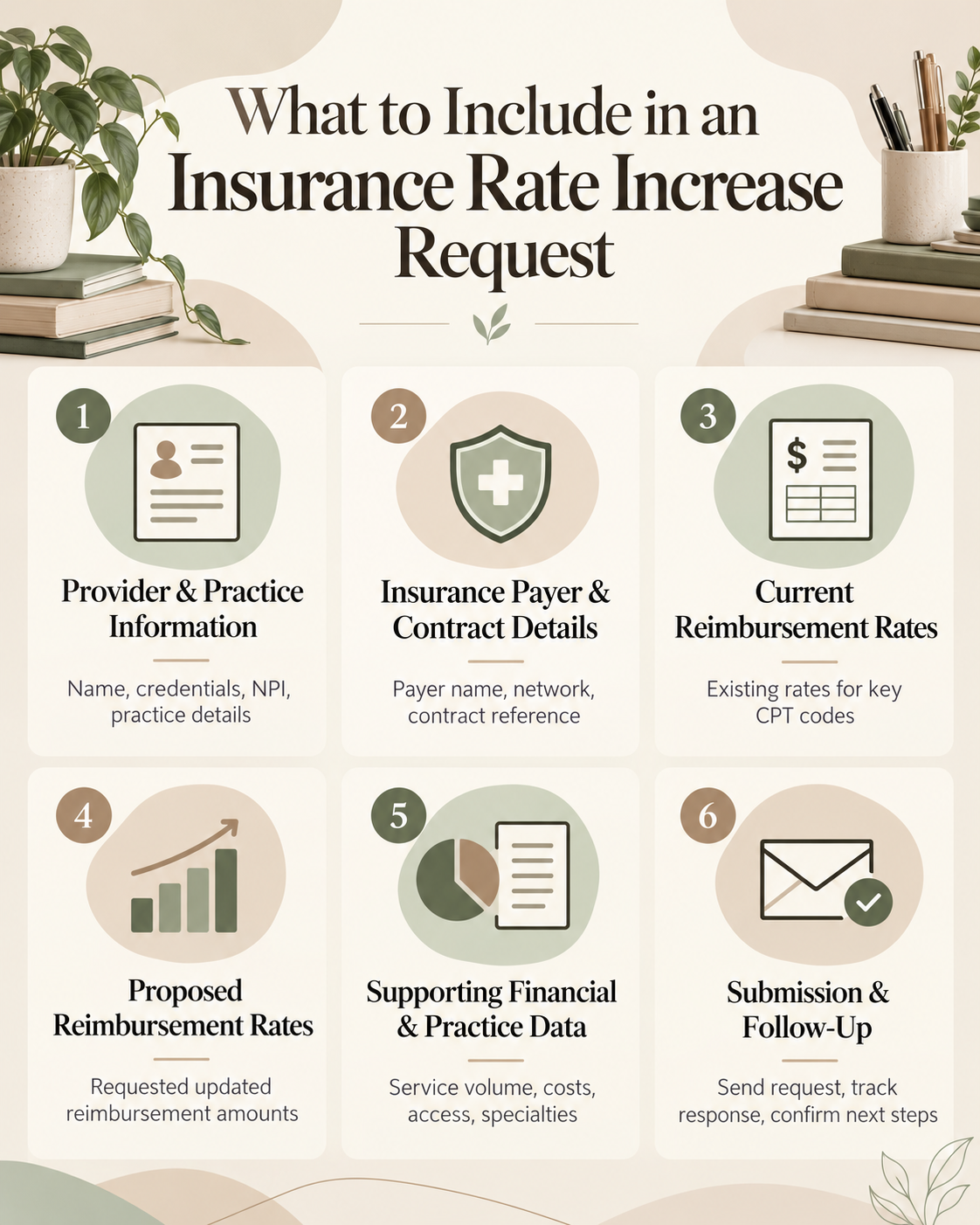
Example of a Rate-Review Request
The following is a sample administrative letter with placeholder information. It does not represent a real negotiation or a guaranteed method of obtaining an increase.
Subject: Request for Contracted Reimbursement Rate Review
Dear Provider Contracting Team,
I am requesting a review of the current reimbursement rates associated with our participating provider agreement for [practice name], [tax identification or contract reference], under [network name].
Our practice currently provides outpatient behavioral-health services to members of your network. During the past [verified reporting period], we completed [verified number] covered appointments and maintained [relevant, documented appointment availability or service capacity].
We are requesting a reimbursement review for the following CPT codes: [codes]. Our current contracted rates are [verified amounts], and the proposed rates are [requested amounts].
This request reflects our documented service volume, operating costs, and the clinical services and access our practice provides within your network. Supporting information is available for the contracting team's review.
Please confirm receipt and advise us of the applicable review process, any additional documentation required, and the procedure for communicating a decision.
Sincerely,
[Authorized provider or practice representative]
[Professional credentials and practice information]
[Contact information]
Why Specificity Matters
A request stating only that insurance reimbursement is too low does not establish which contractual terms need changing.
A clear request identifies the affected services and the financial adjustment proposed.
It also provides a defined basis for further discussion.
The payer may request additional documentation or propose a different adjustment.
That response should be evaluated against the practice's original business case rather than treated as automatic approval or rejection.
Handle Negotiations, Counteroffers, and Rejections
Submitting a rate-review request does not complete the negotiation.
The insurer may offer a partial increase, apply a different reimbursement methodology, defer the request, or explain that the relevant network does not currently permit individualized adjustments.
Each outcome requires a different decision.
Evaluate a Partial Rate Increase
Suppose a therapist requests a $15 increase for a frequently billed service, but the payer offers $7.
The practice should calculate the effect of the proposed $7 adjustment using its actual service volume.
It should also review any conditions attached to the offer.
A smaller increase may still be financially meaningful when the payer accounts for a substantial portion of the practice's caseload.
Conversely, a larger numerical increase may have limited impact if it applies only to a rarely furnished service.
The correct comparison is between the proposed agreement and the practice's financial and operational requirements.
Ask for Clarification When the Response Is Unclear
A payer may describe an offer as an updated fee schedule without specifying every affected service.
The practice should clarify:
Which codes are included.
Which provider licenses or clinician categories are affected.
Which service locations and networks are covered.
How the rates will be calculated.
The proposed effective date.
Any changes to related contract terms.
A written explanation helps prevent misunderstandings when the new rates are implemented.
A Rejection Does Not Establish That Every Future Request Will Fail
Some insurers may maintain standardized rates and decline provider-specific negotiations.
Others may be unable to offer changes under their current network arrangements.
The practice can ask if the payer has a future contracting review process, but it should not assume reconsideration is guaranteed.
The practical decision is to determine if continued participation remains sustainable under the current contract.
That assessment should account for existing clients, the practice's financial position, and its contractual obligations.
Review Contract Terms Beyond the Reimbursement Amount
A higher reimbursement rate is useful only when the surrounding agreement supports appropriate payment and manageable administrative responsibilities.
Payer contracts contain terms that can affect the actual value of an increase.
The American Medical Association's payer-contract review resources emphasize examining more than the headline payment rate.
Confirm the Reimbursement Methodology
A contract may establish payment through a code-specific dollar schedule, a defined percentage of another schedule, or a different reimbursement methodology.
The practice should identify the complete calculation.
For agreements tied to the Medicare Physician Fee Schedule, a percentage of Medicare does not necessarily establish a single unchanging dollar amount.
Medicare rates can vary by code, year, geographic payment locality, and other applicable factors.
CMS provides a Physician Fee Schedule lookup tool that can support understanding of the relevant published Medicare amounts.
Public Medicare rates are reference information. They do not automatically determine the amount a commercial insurer must pay.
Examine Other Financial and Administrative Terms
The agreement may include provisions addressing claim-submission deadlines, payment disputes, applicable networks, amendments, contract termination, and future changes to fee schedules.
Those details can affect the practical financial value of an agreement.
A rate increase accompanied by a material change in reimbursement methodology or participation requirements may have a different impact from a straightforward increase to existing rates.
A practice should review unfamiliar or significant contractual changes with an appropriately qualified advisor.
Consider Telehealth Payment Arrangements
Telehealth reimbursement should not be assumed identical to in-person reimbursement for every payer or plan.
The practice should establish if the proposed rates apply to virtual services and if different codes, modifiers, or place-of-service requirements affect payment.
Do not change billing codes or clinical documentation to obtain a higher negotiated amount.
The payer-specific rules discussed in telehealth billing for therapists remain applicable regardless of a contractual reimbursement increase.
Confirm and Implement an Approved Rate Increase
A verbal statement from a payer representative is not sufficient evidence that a new reimbursement amount applies to every future claim.
The practice should obtain the applicable written confirmation and establish the effective date.
An approved adjustment still requires implementation and payment verification.
Confirm the Written Terms
Review the amendment or updated fee schedule to determine the affected network, provider, codes, rates, and start date.
The practice should also identify which authorized representative must sign or acknowledge the change.
Do not assume that an increase applies retroactively.
A payer may specify that the new rates apply only to services furnished on or after a defined date.
The organization should retain the final agreement with the corresponding provider records.
Update the Billing System Appropriately
Once the revised contractual information is confirmed, the person responsible for billing can update expected allowed amounts or other appropriate financial settings in the EHR.
The implementation should distinguish:
The old contracted rate.
The new contracted rate.
The effective date.
The affected payer and network.
The applicable clinician or organization.
Any relevant code or service-specific restrictions.
An EHR configuration change does not itself amend an insurer's contract.
The payer must have accepted and implemented the applicable terms.
For practices using SimplePractice, insurance billing and payment administration involves related claim monitoring and remittance reconciliation responsibilities.
Review Claims After Implementation
The first claims processed under the new agreement deserve particular attention.
The practice should compare the adjudicated allowed amount against the approved rate and confirm the correct service date and provider information.
A mismatch may indicate that the payer has not loaded the amendment correctly or that the claim was processed under a different network arrangement.
A payment discrepancy should be addressed through the appropriate claims or contracting process.
The practice should continue monitoring outstanding insurance claims and accounts receivable to identify delayed or unresolved payment issues.
How Negotiations Differ for Solo and Group Practices
The process depends partly on who holds the participating agreement.
A solo practitioner commonly negotiates within an individual provider arrangement.
A group practice may have an organizational contract involving several rendering clinicians, service locations, or professional classifications.
Solo Therapists
A solo therapist typically has a smaller administrative operation and may have limited time to prepare financial reports or communicate with contracting departments.
The strongest initial request generally focuses on the services actually provided and the demonstrated contribution to the payer's network.
An established solo clinician with a high volume of network members may have useful service data even without group-practice resources.
However, a busy caseload does not guarantee that the insurer will agree to individual rates.
The owner should assess the time required for negotiation against the potential financial impact.
Group-Practice Owners
A group practice needs to confirm which clinicians are covered by the contract and how reimbursement differs across provider types.
A psychologist, clinical social worker, counselor, and psychiatrist may not share the same contracting category or eligible service codes.
The organization should not assume that a rate approved for one clinician automatically applies to every provider.
The payer may require different contractual records or implementation steps for individual clinicians.
Practice managers can support the process by organizing agreement versions, provider identifiers, supporting reports, and effective dates.
The broader responsibilities associated with mental health practice administration remain relevant when a group maintains several insurance relationships.
Commercial Insurance, Medicare, and Medicaid Rate Differences
Not every insurer follows a commercial contracting model that permits individual reimbursement negotiations.
Understanding the payer type is necessary before preparing a request.
Commercial Insurance
Commercial health plans may negotiate provider contracts, subject to applicable laws and the payer's own policies.
Some contracts use individualized rates. Others rely on standardized schedules or network-level arrangements.
A therapist may submit a rate-review request under the relevant contract process, but approval remains the insurer's decision.
Original Medicare
Original Medicare generally uses federally established payment methodologies and published fee schedules.
A therapist cannot assume that Medicare reimbursement can be individually renegotiated through the same process used for a commercial participating provider agreement.
The relevant Medicare Physician Fee Schedule and provider-specific payment rules determine the applicable amount.
The distinction between Original Medicare and Medicare Advantage is important because Medicare Advantage plans involve separate plan and network arrangements.
HireGaynell's discussion of Medicare enrollment for counselors and marriage and family therapists addresses the provider-participation context separately.
Medicaid
Medicaid reimbursement arrangements depend on the state program and the applicable delivery system.
A state fee-for-service Medicaid program may use published state payment schedules.
Medicaid managed care organizations may operate under separate contracts and network arrangements.
A practice should establish which organization controls the applicable rate before assuming a commercial contracting procedure is available.
State-specific requirements need verification because one state's rules cannot be treated as national Medicaid policy.
Mistakes That Can Weaken a Rate Negotiation
The most damaging errors occur when the practice bases its request on incomplete information or misunderstands the existing agreement.
Some mistakes can also introduce legal or professional risk.
Using Unverified Reimbursement Comparisons
Online discussions sometimes contain individual provider rates without enough information to establish the payer product, contract type, date, location, or professional classification.
Two therapists may report different reimbursement amounts for the same CPT code and both figures may be accurate under their respective agreements.
Publicly available pricing information can provide context, but the practice should examine the source and comparability carefully.
CMS explains that certain commercial plans publish negotiated rate information through Transparency in Coverage machine-readable files.
Those files may be large and technically difficult to interpret. A reported amount should not be used as a direct benchmark without establishing the relevant network, code, provider classification, location, and reimbursement methodology.
Coordinating Prices With Competing Practices
Independent therapists should exercise care when discussing contracting strategies with other competing providers.
Federal antitrust law can restrict agreements among independent competitors to jointly set reimbursement rates, coordinate collective bargaining, or engage in collective refusals to contract.
The Federal Trade Commission and Department of Justice have addressed such conduct in healthcare markets.
A therapist may conduct lawful independent negotiations, but the existence of a professional association or shared frustration about low reimbursement does not automatically permit competing practices to coordinate rates.
A proposed joint contracting arrangement requires appropriate legal review.
Threatening Termination Without Reviewing the Contract
A therapist may consider leaving an insurance network if reimbursement remains financially unsustainable.
However, a statement about terminating participation should not be treated as a routine negotiation tactic without understanding the agreement.
Contracts can impose notice periods, procedural requirements, and other obligations.
Termination can also affect existing clients who rely on their insurance benefits for ongoing treatment.
The business decision should account for client continuity and financial consequences, not only the desired rate.
Submitting Inaccurate Provider Information
A contracting request based on outdated provider records may require additional clarification or delay.
Before making the request, verify the applicable licensing, business, and network information.
The continuing responsibility for maintaining CAQH provider information is related to credentialing and record accuracy, although a current CAQH profile does not guarantee a rate increase.
The practice should keep its contractual and professional records consistent.
When a Rate Increase Is Not Available
A therapist may prepare a complete request and still receive a refusal.
The insurer may not offer individualized negotiations for the applicable network. It may also decline because of its current contracting priorities or payment structure.
The practice needs to assess its next decision using the available facts.
Continue Under the Existing Agreement
Remaining in network may be financially reasonable when reimbursement supports sustainable operations and the practice serves a substantial number of members.
A rate that is lower than the therapist's preferred private-pay fee does not automatically make participation unprofitable.
The practice should consider appointment volume, actual collections, administrative costs, and the impact on client access.
Reduce Avoidable Administrative Costs
Improving claims accuracy and billing follow-up does not change the contracted rate.
It can, however, improve the practice's ability to collect amounts already due under the agreement.
For example, repeated incorrect provider information or unresolved claim denials can reduce realized revenue without any change to the fee schedule.
The distinction matters because an insurer's refusal to increase reimbursement does not excuse avoidable billing errors.
The process for addressing denied insurance claims belongs to a separate financial responsibility from contract negotiations.
Reassess Network Participation Carefully
A practice may determine that a particular commercial insurance agreement is no longer sustainable.
That decision should follow a review of contract requirements, potential client consequences, and alternative payment arrangements.
A transition to private pay is not automatically permitted for every currently insured client and covered service.
Contractual, Medicare, Medicaid, and other applicable requirements need separate attention.
The goal is a financially sustainable practice that maintains appropriate obligations to the people receiving care.
Managing Rate Negotiations Without Disrupting Billing
A reimbursement request can require several rounds of administrative communication.
The practice may need to collect financial reports, locate agreement documents, correspond with contracting departments, monitor responses, and preserve approved amendments.
These responsibilities should have clear ownership.
An authorized practice owner or representative should retain responsibility for contractual decisions.
Administrative staff can assist with assembling permitted information, tracking submissions, maintaining records, and coordinating implementation within their approved role.
A virtual assistant or billing administrator should not be represented as authorized to negotiate or execute contracts unless the appropriate authority and service arrangement have been established.
HireGaynell offers private-practice administrative consulting for operational systems and decisions. That connection is relevant to organizing the process, but it should not be interpreted as an advertised guarantee of payer contract negotiation or rate increases.
Once a new agreement is approved, responsibility shifts toward maintaining accurate records and verifying payments.
The financial value of an increased rate depends on the practice receiving the correct amount for eligible services under the revised terms.
What Determines a Strong Insurance Reimbursement Negotiation?
The strongest reimbursement negotiation is based on a clear understanding of the existing contract, a financially justified request, and accurate evidence of the provider's contribution to the insurance network.
A therapist should know which rates need review, which organization controls the agreement, and what change would materially improve the practice's operations.
The request needs to identify specific services and proposed terms, supported by verified practice information.
A commercial insurer may approve the request, offer a different arrangement, or retain the existing schedule. The practice must evaluate that response against its financial needs and contractual responsibilities.
The process does not end when an increase is announced. Written approval, effective dates, correct EHR configuration, and payment reconciliation determine if the negotiated adjustment actually reaches the practice.
Frequently Asked Questions
How can a therapist get more clients without paying for advertising?
Therapists can improve their website information, maintain accurate professional directory profiles, build referral relationships, and participate in appropriate community education. These activities still require time, and their results depend on local demand, practice specialty, availability, and the consistency of the work.
How do new therapists get their first clients?
New therapists commonly begin with professional directory profiles, referral relationships, a clear website, and accurate information about their services and appointment availability. Their licenses, clinical scope, privacy procedures, and business systems need to be established before accepting clients independently.
Is Psychology Today worth using to get therapy clients?
Psychology Today can be a useful directory for prospective clients searching by specialty, insurance, location, and availability. Its value to an individual practice depends on how many suitable inquiries the profile produces and the cost of maintaining it. A therapist should assess actual appointments generated, not profile views alone.
How long does it take to build a private therapy caseload?
There is no reliable universal timeline. Caseload growth depends on specialty, local demand, insurance participation, existing referral relationships, appointment availability, marketing activity, and the practice's ability to handle inquiries. Projections should be based on actual activity and available clinical capacity.
Can therapists get clients through Google?
Eligible practices may receive inquiries through local Google listings, and therapist websites can appear in relevant organic search results. Accurate business information, helpful service pages, and an accessible contact process support visibility and usability. A specific ranking or number of new clients cannot be guaranteed.
Should therapists use social media to attract clients?
Social media can support professional visibility and general education, but it is not essential for every therapist. Practices should consider audience relevance, time requirements, professional boundaries, and privacy obligations before investing heavily in the channel.
What should a therapist do when inquiries are not becoming appointments?
Review the suitability of incoming inquiries, payment information, appointment availability, administrative response procedures, and the steps required to schedule the first session. A high number of inquiries with relatively few bookings may indicate scheduling or administrative friction, not a need for additional advertising.
Can a virtual assistant help a therapist get more clients?
A specialized virtual assistant may support the administrative work surrounding new-client inquiries, scheduling, routine communication, directory maintenance, and intake coordination. These functions can improve consistency, but an assistant cannot guarantee caseload growth or independently make clinical suitability decisions.
