
Private Pay vs Insurance for Therapists: Which Model Fits Your Practice?
Private pay vs insurance for therapists is a decision about how a mental health practice earns revenue, attracts clients, collects payments, and manages administrative responsibilities. A private-pay therapist receives payment directly from clients, generally according to the practice's established fee policy. An in-network therapist accepts contracted reimbursement arrangements with participating insurance plans and shares payment collection between the insurer and the client according to the plan's benefits.
The higher amount charged for a private-pay session does not automatically produce greater income. A therapist accepting insurance may earn less per appointment but maintain a busier calendar. A private-pay therapist may collect more per session but need additional time to attract and retain clients who can afford the full fee.
For solo therapists, counselors, psychologists, psychiatrists, group-practice owners, and practice managers, the stronger payment model depends on collected revenue, available appointments, client demand, administrative expenses, and the payer agreements involved. A mixed model can provide flexibility, but its rules require careful attention before the practice bills the same service through different payment arrangements.
Private Pay, Insurance, and Out-of-Network Therapy Are Not the Same
A therapy practice generally operates through private-pay arrangements, in-network insurance participation, or a combination of both. Out-of-network reimbursement introduces a separate consideration because a client may pay the therapist directly and later seek reimbursement through their insurance plan.
Understanding the distinctions matters before comparing fees and projected income. Two therapists may both collect payment directly from their clients, yet one may provide documentation for out-of-network insurance claims and the other may treat every appointment as an entirely self-funded service.
How Private-Pay Therapy Works
In a private-pay therapy practice, the client is directly responsible for the agreed session fee. The practice establishes its pricing and financial policies, subject to applicable law, professional obligations, and contractual limitations.
Payment may be collected before or after an appointment according to the disclosed policy. The therapist generally does not submit an in-network claim for that self-pay service, although arrangements involving out-of-network benefits may still require accurate insurance documentation.
For example, a therapist with a published fee of $165 per appointment may collect that amount directly from a client whose services are not being billed to an insurer. The practice should have a clear procedure for receipts, financial consent, payment collection, and any Good Faith Estimate requirement.
Private pay gives a practice more control over its standard fee. It does not eliminate the need for accurate records, privacy protections, professional documentation, or financial accountability.
Therapists establishing their first payment policies should coordinate those decisions with their broader private-practice launch and administrative setup, including the EHR, intake forms, and payment processes.
How In-Network Insurance Billing Works
An in-network therapist participates in an insurance network under an applicable agreement. The payer's fee schedule establishes the allowed amount for covered services, with payment divided between the insurer and the client according to benefit terms.
Consider a hypothetical psychotherapy session with a contracted allowed amount of $120.
If the client's plan assigns a $30 copayment and the claim is otherwise payable, the insurer may pay $90 and the client pays $30. The practice's total expected collection is $120, not $120 from the insurer plus another $30 from the client.
A different client might owe the entire $120 allowed amount because the deductible has not been met. Another may owe coinsurance calculated from the allowed amount.
The specific outcome depends on the claim, plan benefits, provider participation, and payer processing.
Joining an insurance network involves credentialing, contracting, and enrollment-related administration. These processes are connected but not interchangeable. The detailed work of insurance credentialing for therapists belongs to the network-participation stage, before the practice treats a client as in network.
Where Out-of-Network Therapy Fits
Out-of-network therapy describes services furnished by a clinician who does not participate in the client's applicable insurance network.
The client may pay the therapist directly and, when their plan includes out-of-network benefits, submit a claim for possible reimbursement. Some practices provide superbills for that purpose.
Reimbursement is not guaranteed. Plans can apply separate deductibles, coinsurance, allowed amounts, documentation requirements, and exclusions.
A therapist charging $175 does not establish that an insurer will calculate reimbursement using the entire $175 fee. The plan may apply a lower recognized amount and its own cost-sharing rules.
An out-of-network arrangement therefore creates two different financial questions: what the client owes the therapist and what the insurer may reimburse the client.
How the Payment Models Compare
The distinction between payment models becomes more useful when examined through business operations, not simply fee levels.
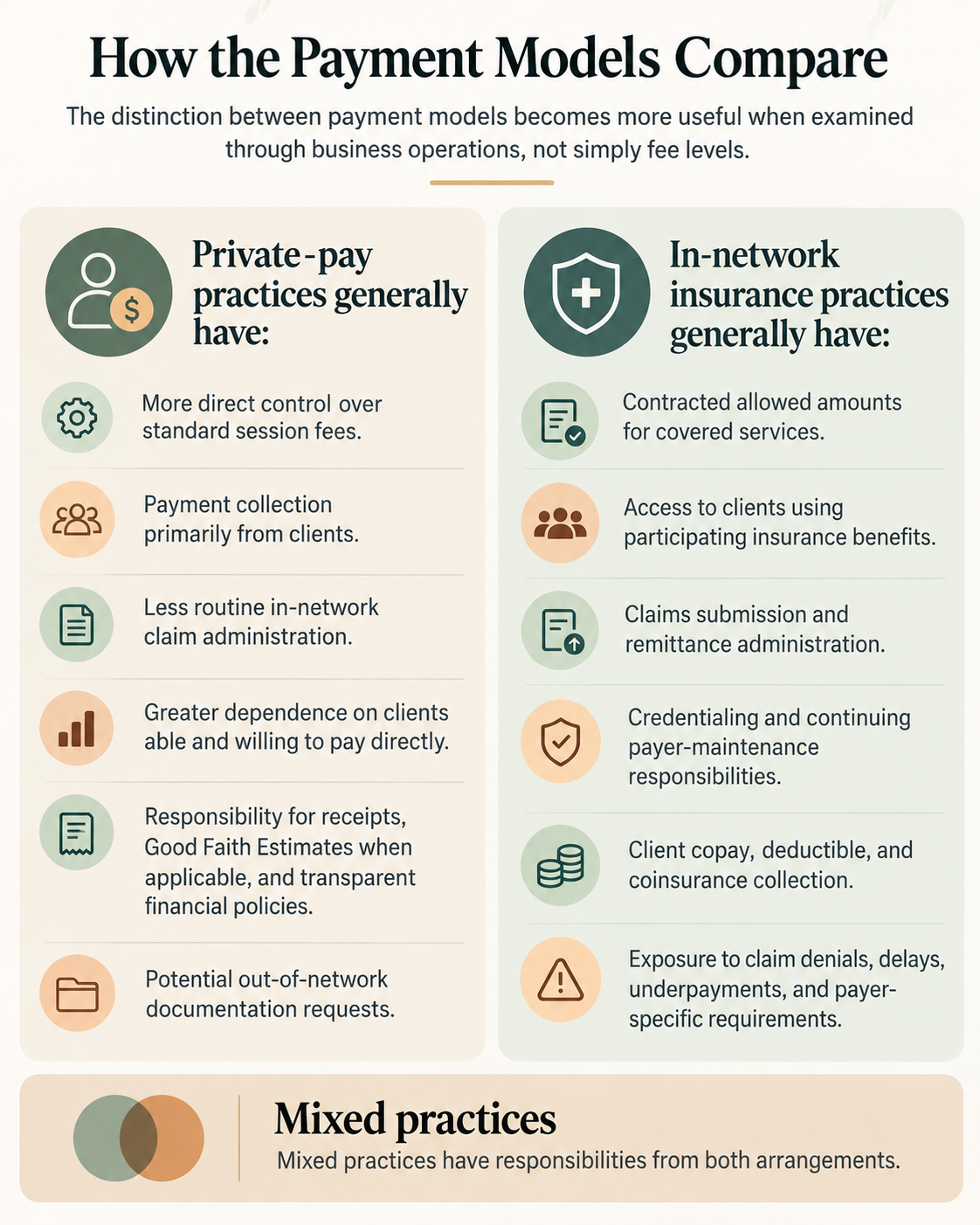
The administrative burden depends on how many clinicians, payers, service types, and payment workflows the practice manages. A mixed model can work effectively when each client's payment arrangement is established correctly and the EHR records the appropriate billing information.
The key mistake is assuming that one model is superior based on its advantages alone. Revenue, demand, collection reliability, and owner time need to be considered together.
Does Private Pay Produce More Revenue Than Insurance?

Private pay can generate more revenue per attended session, but it does not automatically generate more monthly revenue or higher profit.
Practice profitability depends on the number of completed sessions, the amount actually collected, and the expenses required to operate the business.
A therapist who charges $180 privately but books only ten appointments per week may collect less than an in-network therapist whose allowed amount is $120 and who consistently completes seventeen appointments.
That difference becomes more significant when the private-pay therapist spends additional time on referral relationships, advertising, and practice promotion.
Compare Collected Revenue, Not Advertised Fees
The correct starting point is the money the practice collects for services actually delivered.
A published private-pay fee is a price, not proof of collection. Discounts, nonpayment, cancellations, unfilled appointments, and outstanding balances can reduce realized revenue.
An insurance reimbursement rate should be compared with the total contracted allowed amount collected from the payer and the client, not just the insurer's payment.
Consider this illustrative comparison.
Private-pay practice
Collected session fee: $175
Attended sessions per week: 12
Weekly collections: $2,100
Annual collections over 46 working weeks: $96,600
Insurance-based practice
Average collected allowed amount: $120
Attended sessions per week: 20
Weekly collections: $2,400
Annual collections over 46 working weeks: $110,400
In this example, the insurance-based practice collects $13,800 more annually despite earning $55 less per appointment.
These numbers are hypothetical and do not represent typical rates, nationally observed caseloads, or an income forecast. Their purpose is to show how utilization can change the financial result.
The comparison is still incomplete until operating expenses are included.
Include the Cost of Unpaid Work
A solo therapist does not spend every working hour conducting billable sessions.
Private-pay administration can involve website maintenance, responding to inquiries, maintaining referral relationships, payment collection, and managing scheduling gaps.
Insurance adds benefit verification, claim preparation, remittance review, payment posting, denial follow-up, and network maintenance.
The value of this time should be included in the business comparison, even when the owner performs it personally and does not issue a separate administrative paycheck.
For example, suppose a therapist spends five additional hours weekly developing private-pay referrals. That time does not appear as an expense in the accounting system unless the therapist pays someone else to perform the work.
It is still time unavailable for clinical appointments, professional development, or personal commitments.
A practice deciding how to attract more therapy clients should assess the number of suitable inquiries each payment model can realistically support.
Revenue Is Not the Same as Take-Home Income
Practice collections must cover the costs of operating the business before they become owner compensation.
Depending on the practice, expenses may include office rent, EHR subscriptions, payment-processing fees, professional insurance, continuing education, administrative staff, outsourced billing, accounting, advertising, and other operating costs.
Group practices also need to account for clinician compensation, payroll obligations, supervision expenses, and organization-level administration.
A higher collection total can still produce a lower operating margin when the associated costs are excessive.
A therapist comparing payment models should evaluate both revenue per attended session and contribution after payment-related administrative costs.
The Hidden Cost of Building a Private-Pay Caseload
A private-pay practice generally needs enough clients who can afford its fees and believe its services are an appropriate fit.
The therapist's clinical skills remain essential, but qualifications alone do not establish a predictable stream of paying clients.
Private-pay practices often rely on a combination of professional referrals, established reputation, website information, specialty positioning, therapist directories, and community relationships.
The amount of work involved varies considerably by region, clinician specialty, existing referral network, and local demand.
A Higher Fee Can Reduce the Number of Suitable Inquiries
Some prospective clients prioritize a specific therapist's qualifications, specialty, or approach and can comfortably pay the full fee.
Others depend on insurance benefits to attend therapy consistently.
A session fee that works for a therapist's business may exceed the amount a particular prospective client can sustain, especially when treatment involves recurring appointments.
This does not make private pay inappropriate. It means the business should evaluate actual client demand before projecting revenue from a desired session rate.
A clinician moving from an established insurance-based caseload to private pay should not assume that the former volume of referrals will continue under the new payment arrangement.
A Full Caseload Has a Different Meaning Under Each Model
A therapist who schedules twenty sessions per week has reached the same appointment volume regardless of payment type.
The effort required to fill and maintain those appointments may differ.
Insurance network participation can make a provider accessible to members using a covered benefit, including people searching within insurer directories.
Private-pay growth may require more direct referral development, although some established clinicians maintain strong demand without extensive promotion.
Neither arrangement guarantees full utilization.
It is useful to distinguish temporary scheduling gaps from persistent demand problems. A therapist with occasional cancellations may need improved appointment coordination. A practice with months of unfilled clinical capacity may need to examine its service positioning, referral sources, location, and pricing.
The right response should follow the evidence.
Client Affordability Can Affect Continuity of Care
A client who can afford an initial self-pay appointment may still struggle to sustain weekly sessions over several months.
A therapy practice should communicate financial expectations before treatment begins and establish appropriate procedures for discussing changes in payment circumstances.
A lower fee may make care accessible to some clients, but fee reductions need a transparent policy.
HireGaynell's article on sliding-scale fees for therapists addresses fee structures and the related payer-contract limitations in detail.
Affordability planning is a professional and operational issue, not merely a method of attracting more clients.
How Accepting Insurance Changes Client Access
Accepting insurance can expand the group of prospective clients who can use their health benefits to pay for therapy.
HealthCare.gov confirms that Marketplace plans cover mental health and substance use disorder services as essential health benefits, although specific coverage details depend on the plan and state.
Insurance coverage does not guarantee that every therapist, treatment service, or appointment arrangement will be covered.
For the practice, joining an applicable network can reduce a financial barrier for some prospective clients. The extent of that benefit depends on actual participation and local demand.
Insurance Participation Is Specific to the Plan
Being contracted with an insurer does not mean the therapist participates in every product or network associated with that company.
Employer-sponsored plans, Marketplace products, Medicare Advantage arrangements, Medicaid managed care, and delegated behavioral-health networks may have different provider relationships.
A practice should establish the exact plans accepted before advertising broad insurance participation.
The number of payer logos on a website is not a reliable measure of actual client access.
For therapists deciding which networks to enter, the selection process covered in joining insurance panels as a therapist is separate from evaluating the broader private-pay-versus-insurance business model.
Insurance Can Improve Accessibility Without Guaranteeing Affordability
An in-network client may still face a deductible, copayment, or coinsurance amount.
A person enrolled in a high-deductible plan may initially owe much of the applicable allowed amount until the deductible is satisfied.
Another client's outpatient mental-health services may involve a fixed copayment after the plan's conditions are met.
The practice needs to communicate the expected financial responsibility without guaranteeing a particular outcome before the insurer processes the claim.
This is especially important when treatment occurs weekly and relatively small misunderstandings about each appointment can accumulate into a substantial balance.
Provider Directory Information Influences Contact Opportunities
Insurer directories may help members locate participating behavioral-health clinicians.
A therapist with inaccurate network information, outdated contact details, or an incorrect acceptance status may have difficulty receiving appropriate inquiries.
Accurate public profiles should therefore be part of ongoing provider administration.
The process for correcting inaccurate insurance directory listings addresses those errors separately.
Insurance participation creates an opportunity for plan members to locate a provider. Maintaining accurate information helps that opportunity function properly.
What Insurance Billing Adds to the Practice
Insurance-based therapy requires more administrative coordination than simply sending a claim after a completed session.
The practice has to establish the correct provider relationship, identify the client's benefits, produce an accurate claim, monitor the payer's response, and reconcile the resulting payment.
The amount of work increases with claim volume, the number of plans accepted, and the complexity of the practice.
Credentialing Approval Does Not Complete the Billing Setup
Credentialing verifies a clinician's qualifications. Contracting establishes the participation terms, and provider enrollment connects the appropriate provider and organization records to the payer's systems.
A clinician who has submitted an application should not assume that in-network claims can begin immediately.
The applicable payer, network, provider identity, group affiliation, and effective date need confirmation.
A therapist with several contracted plans also has continuing responsibilities for updating professional information and maintaining the required records.
Those responsibilities represent real operational costs even in months when claims process without problems.
Benefit Verification Happens Before the Claim
Insurance coverage needs to be examined at the relevant plan and service level.
An active insurance policy does not prove that a particular outpatient mental-health service is covered at the expected rate.
Verification may need to address the member's plan, behavioral-health benefit, deductible, copayment, coinsurance, applicable network, and prior authorization requirements.
For a growing practice, incomplete verification can affect several clients before the first resulting claim problem becomes apparent.
The distinction between eligibility and full benefits is explained in HireGaynell's insurance benefit verification checklist.
A reliable comparison of payment models should count the time or staffing needed for these recurring checks.
Allowed Amounts Need to Be Reconciled Against Payments
An insurance claim's billed charge is not necessarily the amount the practice may collect under its contract.
The payer's allowed amount determines the applicable reimbursement basis for a covered in-network service, subject to the plan's benefit terms.
After adjudication, the practice should compare the expected contracted amount with the remittance and recorded client responsibility.
An Electronic Remittance Advice explains how the claim was processed. An Electronic Funds Transfer moves the insurer's payment. They represent different parts of the payment process.
A remittance that has been posted correctly in the EHR can still contain a rate discrepancy requiring investigation.
The process of reading payer fee schedules and identifying underpayments covers the detailed reconciliation work.
Denials and Outstanding Claims Create Follow-Up Costs
Claims do not all follow the same route from submission to payment.
Some are rejected before adjudication because information is missing or invalid. Others are accepted for processing but later denied.
A practice must determine what happened before deciding on correction, resubmission, reconsideration, or appeal.
Outstanding claims can also remain unresolved without being formally denied.
The administrative expense includes monitoring claim status, reviewing payer explanations, maintaining correspondence, and resolving discrepancies before applicable filing or appeal deadlines expire.
HireGaynell's separate resources on following up on unpaid therapy claims and appealing denied insurance claims address those procedures in depth.
In the business-model comparison, the important question is how frequently those responsibilities arise and how much they cost to manage.
Does Private Pay Reduce Administrative Responsibilities?
Private pay generally removes routine in-network claims submission for services not billed to insurance. It does not eliminate the administrative responsibilities of operating a therapy practice.
The difference is the type of work.
A private-pay practice may spend less time on payer portals and claims reconciliation but more time managing direct payments, fee communication, refunds, and prospective-client inquiries.
An insurance practice adds payer administration yet may benefit from consistent intake systems and a stable network-based referral channel.
Neither model is automatically low maintenance.
Private-Pay Practices Still Need Financial Procedures
A self-pay therapist should maintain written financial policies that explain fees, payment timing, cancellation arrangements, and the handling of unpaid balances.
If a client pays directly, the EHR still needs to record the charge and payment accurately.
The practice should also be prepared to provide receipts and maintain any required patient-facing financial documentation.
For uninsured and applicable self-pay individuals, the federal No Surprises Act generally requires a Good Faith Estimate of expected charges when care is scheduled sufficiently in advance or an estimate is requested.
A Good Faith Estimate is not the final bill. It communicates the anticipated charges, allowing the client to understand potential costs before receiving care.
CMS also provides a dispute-resolution process under qualifying circumstances when the billed amount exceeds the estimate by at least $400.
The full process is addressed in Good Faith Estimates for self-pay therapy clients.
Out-of-Network Clients May Need Superbills
A practice collecting payment from an out-of-network client may be asked to provide documentation for an insurance reimbursement claim.
A superbill can contain provider identifiers, service dates, billing codes, diagnosis information when appropriate, charges, and other payer-required details.
The required information can vary with the claim and plan.
The therapist should not promise reimbursement, guarantee deductible credit, or report charges that do not accurately reflect the services and financial arrangement.
Preparing superbills for out-of-network therapy clients is therefore an administrative responsibility, even when the practice does not file the client's claim directly.
Private Pay Does Not Automatically Exempt a Practice From HIPAA
A therapist's payment arrangement does not, by itself, resolve the practice's privacy obligations.
HHS explains that healthcare-provider status under HIPAA depends in part on conducting covered electronic standard transactions. State laws, professional duties, contracts, and other privacy obligations may also apply.
For HIPAA-covered providers, a client who pays for a service in full out of pocket can request that relevant information not be disclosed to their health plan for payment or healthcare operations. Under the applicable conditions, that request generally must be honored unless disclosure is required by law.
That is a specific privacy right, not a general guarantee that private-pay treatment produces no records or external disclosures.
Payment arrangements and privacy responsibilities should be assessed separately.
Insurance Contracts and the Limits of Cash-Pay Flexibility
A therapist who participates with an insurance network may be subject to contractual rules governing covered services furnished to members of that plan.
For that reason, the decision to accept insurance cannot be separated from the question of when the practice may charge a client directly.
A therapist should not assume that a client can simply elect to pay the full private rate for a covered in-network service without reviewing the applicable agreement and other governing requirements.
Some arrangements may permit specific self-pay situations, but the circumstances, documentation, and restrictions can differ.
In-Network Clients Cannot Automatically Be Charged the Full Private Rate
Consider a therapist who publishes a $180 private-pay fee and has an insurance contract allowing $125 for the same covered service.
For an applicable in-network covered claim, the practice generally cannot collect the difference between its published charge and the contracted allowed amount simply because its private fee is higher.
The amount beyond the allowed rate is generally handled as a contractual adjustment, not automatically transferred to the client.
Commercial payer agreements need review before establishing exceptions.
The question becomes more complicated when a client asks the therapist not to submit insurance for a covered service. HIPAA rules on restricting certain health-plan disclosures may be relevant, but that privacy right does not automatically resolve every contractual billing restriction.
The practice should verify the applicable requirements before accepting an alternative payment arrangement.
Copayments and Financial-Hardship Policies Need Care
A therapist may want to reduce the financial burden on a client experiencing hardship.
The practice should not automatically waive required cost sharing without considering its payer agreements and applicable law.
Routine cost-sharing waivers can create particular federal compliance concerns under Medicare and other federal healthcare programs.
Commercial plans may impose additional contractual restrictions.
A consistent written financial-hardship policy can help the practice document decisions, but it should not be treated as blanket authorization to disregard a payer agreement.
The mechanics of collecting copayments and managing past-due balances belong to the separate billing-policy workflow.
Medicare and Medicaid Require Special Consideration
Private-pay arrangements involving Medicare or Medicaid beneficiaries may be governed by requirements beyond ordinary commercial insurance contracts.
CMS explains that eligible clinicians who opt out of Medicare must follow the applicable opt-out process and enter into qualifying private contracts with Medicare patients. The rules are not the same as simply deciding to stop submitting commercial insurance claims.
Relevant mental-health professions eligible for Medicare opt-out include clinical psychologists, clinical social workers, marriage and family therapists, mental health counselors, and certain medical practitioners.
Medicaid rules depend on the program, state, provider participation arrangement, and service involved.
A practice should not assume that accepting cash directly from a Medicaid beneficiary for a covered service is permissible merely because the client agrees to pay.
These circumstances require payer-specific and program-specific verification before the financial policy is applied.
When a Mixed Payment Model Makes Sense
A mixed or hybrid therapy practice combines insurance-based services with private-pay arrangements.
This can allow the business to serve clients using participating insurance benefits and others who pay directly.
It may also allow different clinicians within a group to maintain different payer relationships, provided provider-specific and organizational requirements are met.
The benefit is flexibility. The challenge is managing the arrangements accurately.
A Mixed Practice Needs Clear Client-Level Financial Records
Every scheduled service should have an established payment arrangement.
The practice must know which clinician is delivering the service, which payer relationship applies, how the client is being billed, and what documentation is required.
A group practice may have a psychologist participating with one insurer and an LCSW who has a different set of network agreements.
The organization should not assume that the group practice's participation automatically establishes identical network status for every clinician.
Provider-level information matters for both financial estimates and claims.
Administrative complexity increases when the practice adds new clinicians, service locations, insurance networks, and payment arrangements.
Some Services May Follow Different Payment Rules
A practice may offer different clinical services with different coverage considerations.
For example, a clinician might provide covered outpatient psychotherapy and another service that a particular plan does not cover.
The practice cannot determine that an appointment is private pay simply because the service is described differently on its website.
The actual service, clinician's scope, coverage terms, payer contract, and applicable law determine the correct handling.
Psychologists offering psychological testing, psychiatrists providing medication-management services, and clinicians offering specialized treatment formats may face different benefit and billing questions.
These distinctions should be checked at the service and plan level, not generalized from a standard individual psychotherapy appointment.
The EHR Must Support Both Arrangements
A mixed practice needs correct client billing profiles, fee settings, payment methods, and insurance records.
The system must also help staff distinguish an insurance receivable from a client balance.
Incorrect configuration can create duplicate charges, incorrect financial responsibility, or claims submitted under the wrong provider record.
A billing system can reduce manual work, but it cannot decide which payment arrangement is legally or contractually appropriate.
The features discussed in billing software for private therapy practices provide additional context for selecting appropriate administrative tools.
For practices using SimplePractice, billing administration and payment tracking may be relevant when claims and financial records require recurring oversight.
How the Decision Changes for Solo and Group Practices
Payment models affect solo practitioners differently from group practices because the number of clinicians changes staffing, credentialing, and financial responsibilities.
A solo therapist can often maintain a relatively simple private-pay system. An insurance-based solo practice may need to divide time between clinical sessions and payer administration.
A group practice can distribute responsibilities among employees or contractors but also has more provider records, schedules, and payment arrangements to coordinate.
The best fit depends on actual workload.
Solo Therapists Need to Account for Owner Time
A solo therapist with an established private-pay referral network and a reliably full schedule may have little business reason to join additional insurance panels.
Another therapist entering a market where many prospective clients depend on insurance may struggle to reach a sustainable caseload using private pay alone.
Neither scenario proves that the payment model itself is universally more profitable.
The owner should compare completed appointments, collections, administrative time, operating expenses, and referral reliability.
A simple, stable private-pay practice may not need specialized claims administration.
An insurance-based solo practice with several payer relationships may benefit from structured billing support, but the cost must be justified against its actual workload.
Group Practices Must Evaluate Each Clinician
For a group practice, profitability should not be evaluated only at the organization level.
Different clinicians may have different fee schedules, reimbursement arrangements, schedules, clinical specialties, and appointment utilization.
A psychiatrist's medication-management appointments are not financially equivalent to an LCSW's psychotherapy sessions. A psychologist providing assessments may have different service costs and administrative requirements from a clinician offering recurring individual therapy.
The practice manager should evaluate each service line using its own assumptions.
An apparent revenue advantage from one insurance plan may not apply to every clinician or service.
Adding providers can increase available clinical hours without automatically increasing the number of billable appointments.
Practice Managers Need Consistent Administrative Ownership
A group-practice manager may be responsible for coordinating clinician participation records, scheduling, payment posting, client balances, and reporting.
The practice should establish who maintains payer contracts, who verifies client benefits, who reviews claims, and who reconciles the resulting payments.
For private-pay clients, it should establish responsibility for financial agreements, Good Faith Estimates where applicable, payment collection, and overdue balances.
These tasks need defined ownership regardless of the payment model.
Ongoing mental health practice administration can encompass several of these organizational responsibilities, depending on the specific arrangement and approved scope.
What to Measure Before Changing Payment Models
A therapist considering a move from insurance to private pay, or from private pay into insurance, should examine actual practice records before making the decision.
An advertised fee and an estimated number of appointments are not enough.
The financial review should cover a representative period and account for predictable fluctuations in scheduling.
First, Establish the Current Financial Baseline
Review the practice's:
Average collected revenue per attended session.
Attended appointments per clinician.
New-client inquiries and conversion to appointments.
Administrative and billing expenses.
Unpaid insurance claims and client balances.
Payment delays and unresolved denials.
Clinician availability and unused appointment capacity.
Revenue concentration across major payers.
Referral sources and demand for private-pay appointments.
These figures form the baseline against which a proposed model can be evaluated.
For a newer practice without sufficient historical data, use conservative scenarios and clearly identify the assumptions.
Then Test a Realistic Change in Caseload
A therapist moving toward private pay should estimate how many clients are likely to continue under the new arrangement and how quickly suitable new inquiries may develop.
A practice entering insurance networks should estimate the added billing workload and the time required before in-network participation is operational.
Neither scenario should assume immediate full utilization.
One useful calculation is the minimum number of attended sessions needed to cover the practice's operating expenses at the expected collected amount per appointment.
Suppose a practice has $4,000 in monthly fixed operating expenses and expects to collect $125 per attended session before variable expenses.
It needs 32 attended sessions in that month just to cover those fixed expenses. That calculation does not include variable costs, owner compensation, taxes, or any additional financial reserve.
A model with higher fees may reach that limited threshold with fewer appointments. A model with lower fees may still produce stronger results if it supports enough additional collections.
The practice needs to test both possibilities using realistic demand assumptions.
Review the Transition Before Informing Clients
Changing payment models can affect existing clients, not only the practice's future revenue.
A therapist leaving an insurance network may need to follow contractual termination and notice requirements, examine continuity-of-care considerations, and communicate financial changes appropriately.
Some clients may not be able to continue treatment at the private-pay rate.
Professional responsibilities related to client welfare, referrals, and continuity of care remain relevant.
A practice joining insurance panels should also confirm the correct effective dates before representing clinicians as in network.
Financial changes should be sequenced around confirmed payer information, documentation, and the practice's ability to manage existing commitments.
Which Model Fits Your Practice?
The strongest payment model is the one that supports accessible, financially sustainable care within the practice's actual clinical and administrative capacity.
A private-pay model may be appropriate for an independently licensed therapist with established referral demand, clients able to sustain the fee, and a preference for direct payment administration.
Insurance participation may be appropriate for a practice serving populations that rely on covered mental-health benefits and able to manage the related claims, enrollment, and payment responsibilities.
A mixed model may be appropriate for a practice with enough administrative structure to maintain separate arrangements accurately.
When Private Pay Is a Reasonable Choice
Private pay may be a strong fit when the practice has demonstrated demand at its established rates.
It can also work well when the owner wants a smaller caseload and the revenue projections support the business's expenses and compensation requirements.
The financial advantages become less convincing when the therapist spends substantial unpaid time attracting clients or regularly operates below the required appointment volume.
A full private-pay practice does not necessarily need an insurance billing specialist. It may still need support with scheduling, financial communication, and general operations.
When Insurance Participation Is a Reasonable Choice
Insurance may be a stronger fit when local demand is concentrated among people using health benefits and the applicable contracted rates support sustainable service delivery.
It can also help practices that already have the administrative systems and staff needed for benefit verification, claims, and payment reconciliation.
The financial benefit becomes weaker when low allowed amounts are combined with excessive administrative costs, poor collection practices, or recurring unresolved claims.
Joining additional networks should follow a careful review of expected demand and reimbursement, not an assumption that more contracts automatically increase revenue.
When a Mixed Model Is Worth the Added Complexity
A mixed model can support different client populations and provide more than one source of practice revenue.
It requires accurate client-level financial records and an understanding of which services can be billed under each arrangement.
For small-group practices, this may offer flexibility as clinicians join networks at different times.
For a solo therapist with very low appointment volume, the administrative work of maintaining several arrangements may outweigh the potential advantage.
The final decision should reflect collected revenue, realistic appointment utilization, client affordability, clinician scope, payer contracts, and the amount of non-clinical work the practice can manage consistently.
Frequently Asked Questions
Is private pay better than insurance for therapists?
Private pay can produce a higher amount per session and reduce routine insurance claims administration. Insurance may support greater appointment utilization by allowing clients to use participating health benefits. The financially stronger model depends on actual collections, caseload demand, operating expenses, and unpaid administrative work.
Do therapists make more money accepting insurance or private pay?
Neither payment model guarantees higher earnings. A private-pay therapist may collect more per appointment, but an insurance-based therapist may complete more sessions. Comparing annual revenue after operating and administrative costs provides a more reliable answer than comparing session rates alone.
Can a therapist accept both insurance and private-pay clients?
Yes, a therapist may operate a mixed practice when the arrangements comply with applicable payer agreements, program rules, and professional obligations. The practice must determine the correct payment and billing arrangement for each client and service. Commercial contracts, Medicare rules, and Medicaid requirements can restrict particular cash-pay arrangements.
Can an in-network therapist charge an insured client the full private-pay fee?
Not automatically. For covered in-network services, participating provider agreements generally govern the allowed amount and client responsibility. A request to pay directly does not, by itself, establish permission to disregard contractual requirements. The applicable payer rules and circumstances need review.
Is private-pay therapy completely confidential from insurance companies?
Private-pay treatment generally avoids routine claims disclosure for services not submitted to insurance, but it does not eliminate medical-record, legal, or privacy responsibilities. Under HIPAA, qualifying full out-of-pocket payments can support a requested restriction on certain disclosures to a health plan. Other permitted or required disclosures may still apply.
Do private-pay therapists need to provide a Good Faith Estimate?
Generally, uninsured and applicable self-pay clients are entitled to a Good Faith Estimate when they request one or schedule care sufficiently in advance. The estimate should identify expected charges under the applicable federal requirements. Medicare and Medicaid arrangements may require separate analysis.
Can private-pay therapy clients receive out-of-network reimbursement?
Some can, depending on their insurance benefits and the provider's status. The client may need a superbill or other documentation, and reimbursement can be affected by deductibles, allowed amounts, claim deadlines, and plan exclusions. The therapist should not guarantee the amount or availability of reimbursement.
Can therapists switch from insurance to private pay?
A therapist can consider leaving insurance networks, but existing agreements, termination requirements, client notice obligations, continuity-of-care considerations, and public provider records may need attention. Medicare and Medicaid arrangements require particular care. The practice should confirm the relevant obligations before changing clients' billing arrangements.
Is insurance credentialing necessary for a fully private-pay therapist?
A therapist who does not intend to participate in payer networks generally does not need commercial insurance paneling merely to collect direct payments. Professional licensing, identity, privacy, documentation, and payment obligations remain separate questions. Medicare or Medicaid beneficiary arrangements may create additional program-specific requirements.
Which model is more suitable for a group therapy practice?
A group practice should compare payment models by clinician, service type, reimbursement arrangement, administrative workload, and appointment utilization. Insurance can support access across several provider networks, and private pay can support additional service arrangements. A mixed model requires accurate billing-provider records and consistent financial administration.
